


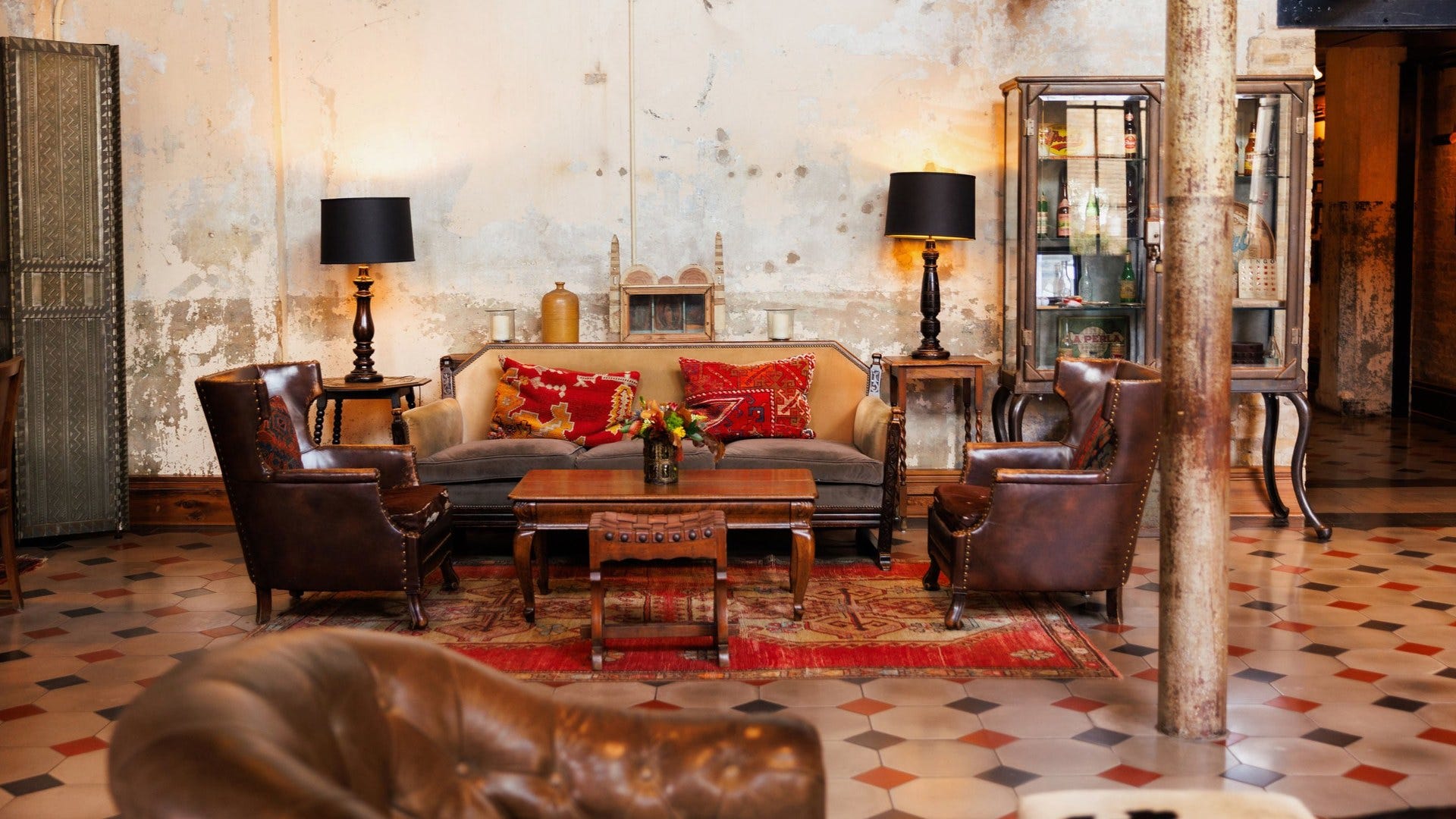
About a year before Hotel Emma opened, I was lucky enough to get a hard hat tour. The hotel was still very much a construction site, all dust, concrete, and hard hats, and you had to use your imagination to see what was coming.
At one point, we walked into the enormous space that would eventually become Sternewirth, and the person giving me the tour said something I still remember.
“We’re actually worried people are going to think they can’t come in here.”
The concern was understandable. This was going to be a beautiful hotel, and Sternewirth was going to be its grand living room. They worried locals might walk through the doors, look around, and assume the space was only for hotel guests. So they wanted people to know: Come in. Sit down. Use it.
I remember thinking: You don’t have to ask me twice. And I didn’t.
When Hotel Emma opened, I was getting ready to write my first book, The Cilantro Diaries. Like most first-time authors, I didn’t really know what I was doing. I just knew I needed places where I could sit for a long time, think, write, edit, delete, rewrite, and stare into the distance when none of those things were working.
One of my favorite places became a corner of Sternewirth with a sofa setup, where I would settle in with my laptop and work, sometimes for hours. A significant portion of my first book, The Cilantro Diaries, was written and edited in that room.
I loved being there. I loved the scale of the room and the feeling that you were somewhere special without feeling like you had to be doing something special to deserve being there.
But over the years, I began to realize Sternewirth was doing more than giving me a good place to write.
It was selling San Antonio.
Around that same time, I was helping recruit a company from Canada to San Antonio. The founder, Steve, was considering moving not only his company, but his family, from Toronto. That is an enormous decision, and anyone who has ever been involved in recruiting a company knows that spreadsheets and tax incentives can only take you so far. At some point, a person has to be able to picture a life here.
I took him to the Pearl, and he loved it. After dinner, we ended up at Sternewirth for a drink. We went upstairs and kept talking.
I remember looking at him and seeing something change, a moment when I could almost see the switch flip in his eyes. San Antonio stopped being a city he was considering and started becoming a city where he could imagine his life.
He eventually made the move. He moved his family and his company here, and they are still here today.
Years later, Steve, who has since become a good friend, gave me one of my favorite descriptions of Sternewirth. We were talking about the Pearl and what made it work when he said something that has stuck with me ever since:
“Sternewirth is San Antonio’s best room.”
I think he is right.
The power of a room
Fast forward to 2024, when I met Dan and Ellie Morrison at Sternewirth. At the time, they weren’t my co-founders. We were simply three people meeting to talk about San Antonio, and we ended up inside one of Sternewirth’s old brewery silos.
We talked about the city we loved, its potential, and the things that frustrated us. Mostly, we talked about how San Antonio needed more places like the Pearl: beautiful, intentional, and distinctly ours.
Somewhere inside that conversation, an idea emerged, and that idea became Voice of San Antonio.
The publication you are reading right now was born inside a beer silo at Sternewirth.
There is something perfect about that to me. Because when I think about my history with this room, I realize something remarkable has happened there. I wrote part of a book there. I watched someone decide to move his company and family to San Antonio there. And years later, I helped start a company there.
Literature, talent recruitment, and company creation, all touched, in some small way, by one really good room.
This is what placemaking does
We sometimes talk about great places as if they are amenities, like good architecture or a cool hotel. But that description misses their real value.
Great places change behavior. They make people linger. They make strangers bump into one another. They help visitors imagine themselves becoming residents.
That is the power of placemaking. And the best placemaking doesn’t have to announce itself. It doesn’t need a giant sign explaining what it is supposed to accomplish. Sometimes it just gives you a really good room, and then people do the rest. They write books, start companies, move across countries, and fall in love with a city.
That is why places like the Pearl matter so much to San Antonio. Their economic impact isn’t limited to hotel rooms booked or meals purchased. Some of their most important contributions will never appear on a spreadsheet. They create a stage on which other things can happen.
I think back to that hard hat tour before Hotel Emma opened and the concern that San Antonians might not realize Sternewirth belonged to them too. More than a decade later, I can report back: Some of us got the message.
I am grateful to the people who imagined Hotel Emma, Sternewirth, and the Pearl, and especially to the people who understood that a beautiful place becomes more valuable when a city is invited inside it.
They gave San Antonio a room. We filled it with stories.
And if you’re building the next great place in San Antonio, don’t just build something beautiful. Build somewhere people can create, meet, and imagine a different future for themselves and for their city.
Build San Antonio’s next best room.
THE VOICE:
Lorenzo Gomez III

Lorenzo Gomez III is a community builder, author, and public speaker who draws from his personal and professional experiences to inspire others. A former director at Rackspace Technology, Gomez is a key player in the development of San Antonio’s downtown entrepreneurial ecosystem. During Gomez’s four years as chairman and CEO of Geekdom, San Antonio’s premier collaborative startup community, Geekdom companies raised more than $422M in funding and its startups have created 2,489 jobs. A trusted advisor to Graham Weston, co-founder of Rackspace Technology, Gomez helped shape Weston’s 80|20 Foundation, which invests in San Antonio’s future by issuing grants to public charities that attract, grow, and retain San Antonio’s future workforce and job-creating entrepreneurs. Gomez has authored four books: Cilantro Diaries, Tafolla Toro, The Rack We Built, and The Bully in Your Pocket. All four are Amazon best sellers and two are winners of the 2021 International Latino Book Awards. Lorenzo’s driving passion is his love for his hometown, San Antonio, Texas. His goal is to recreate for every San Antonian the opportunities the startup world has provided him in this city on the rise.