


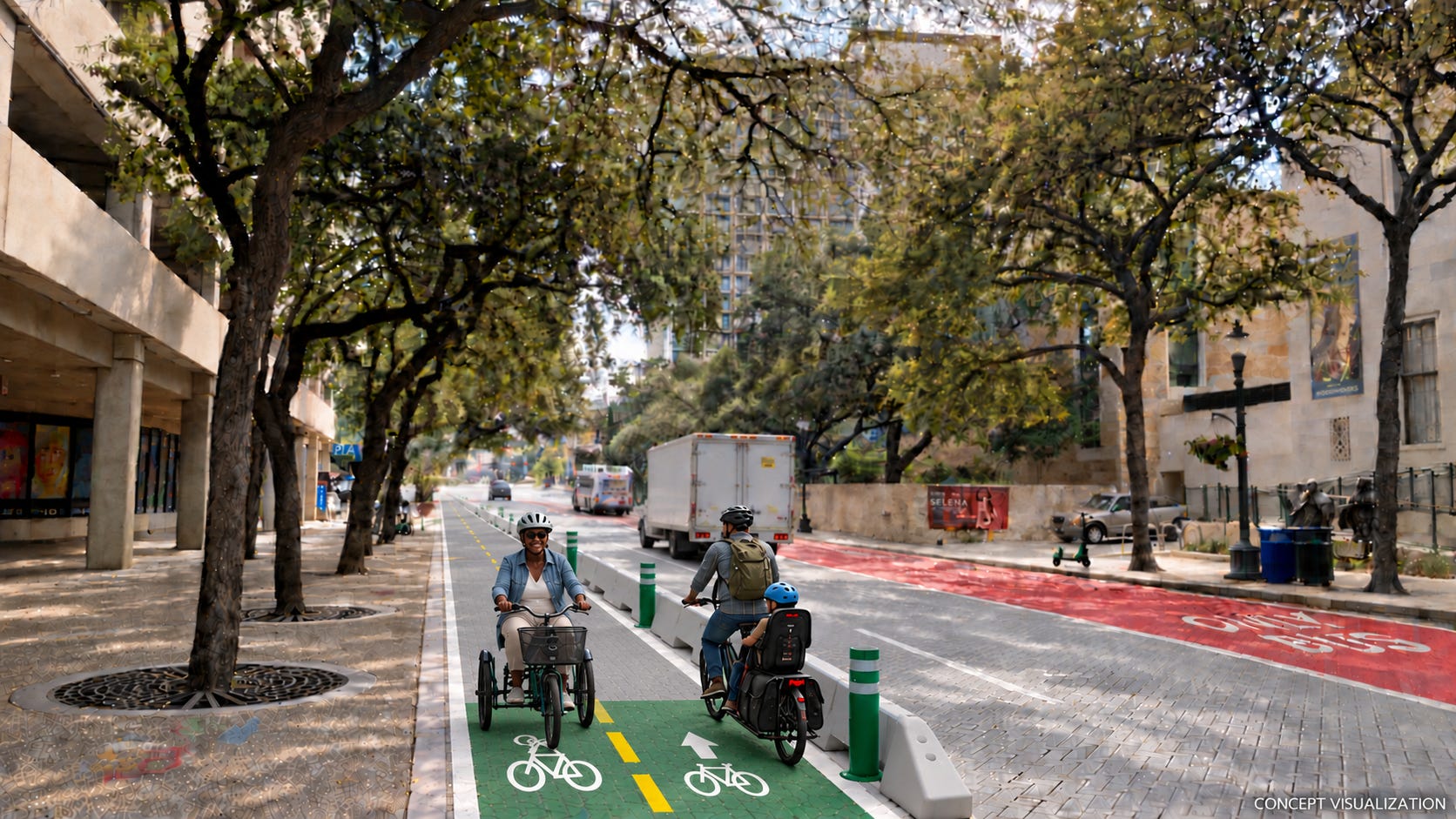
In January 2025, San Antonio made a promise. City Council adopted a Bike Network Plan, shaped by two years of community engagement, that calls for more than 600 miles of new bikeways. The goal, in the city manager’s words, was for residents to “safely and conveniently travel throughout San Antonio on two wheels.” The plan went further, promising a network “comfortable and safe for users of all ability levels,” whether that’s a child riding to school, a grandparent riding to H-E-B, or someone who hasn’t been on a bike in years.
A promise on a map doesn’t keep anyone safe. Connected, protected bike lanes do.
Today, our on-street network is a patchwork. A national ranking scored it 20 out of 100. In 2022, San Antonio was ranked the 16th deadliest city in America for people on bikes. And roughly 200,000 of our neighbors don’t own a car at all. Our 100+ miles of greenway trails are excellent, but many residents still have to drive or risk their life just to reach a trail, a transit stop or a safe route.
The fix for downtown isn’t new, either. A bike lane on Market and Commerce was proposed as early as the City’s 2011 Bike Master Plan. Fifteen years later, San Antonio has finally secured nearly $16 million in state funding to build it.
Downtown has changed a lot in those years. In the 2010s, City leaders declared a “Decade of Downtown” and set a goal of 7,500 new homes in the urban core, a goal the City comfortably exceeded. Cyclists have been asking for safe, protected routes across downtown for just as long. In 2014, the Bike Collective, one of the city’s cycling advocacy groups at the time, surveyed riders across San Antonio. The survey feedback was clear: a protected bikeway across downtown, connecting the Pearl to Blue Star. It was never built. Mayors and master plans have come and gone, yet the connected cycling network to serve the greater downtown area still hasn’t arrived. Market Street won’t solve that alone, but it gives downtown a protected backbone that future connections, north to the Pearl and south to Blue Star, can build on.
Most San Antonians have no idea what will be built on this corridor, or what we lose if we walk away.
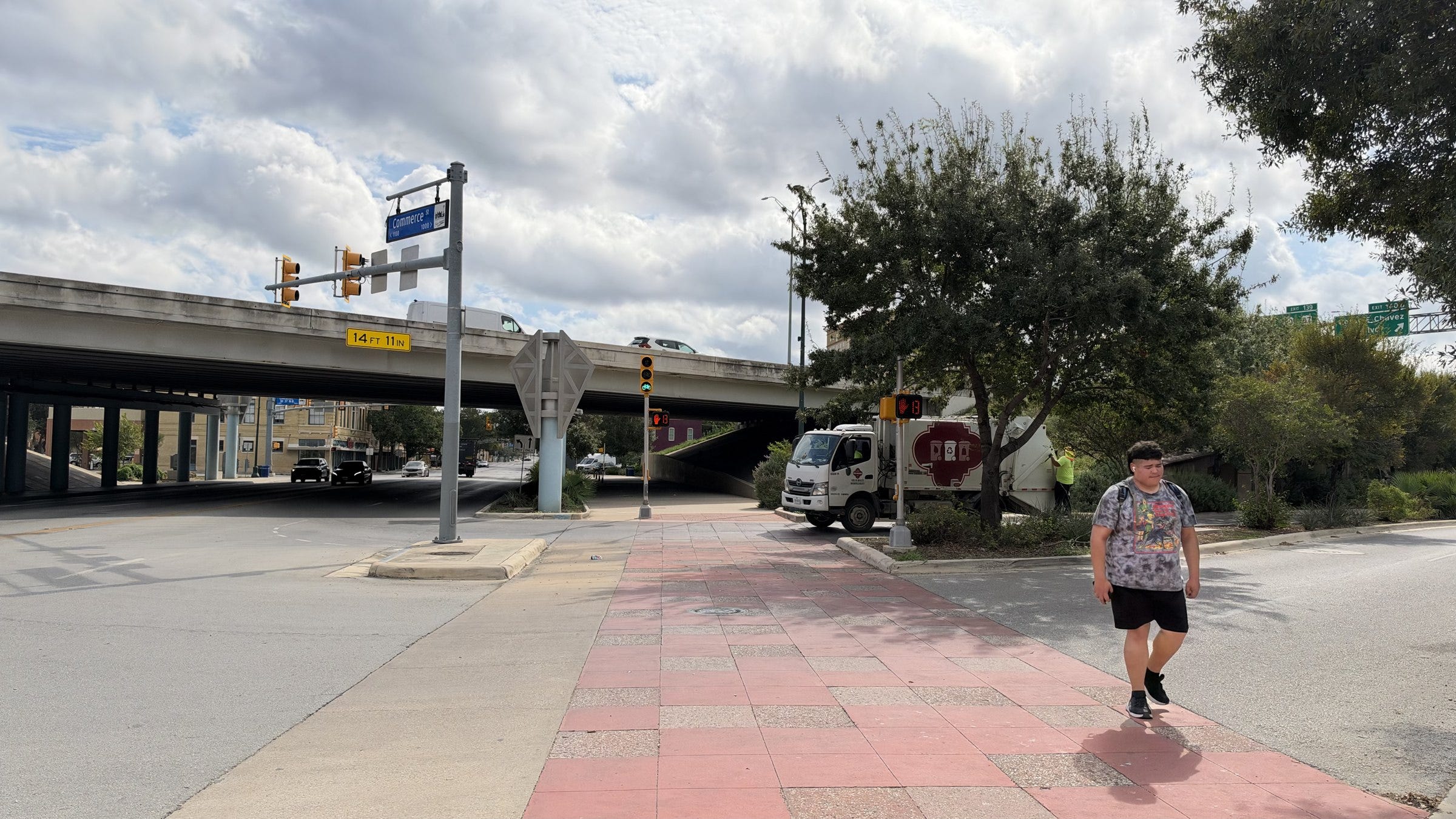
The Market Street Cycle Track would create nearly a mile of protected, two-way bike lane through the heart of downtown, from Flores Street to I-37 along Dolorosa, Market, Alamo and Commerce. It also brings new traffic signals, safety lighting, signage and better pedestrian crossings. The design is complete, and the project is nearly ready to be built.
Let me be clear: I want downtown to work for everyone. That includes the people who drive into it, deliver to it and build businesses in it.
It also includes the people who get there on two or three wheels. Right now, our busiest downtown streets give them almost nothing.
This corridor is not just another layer of streets. It is the key to directly connecting the West Side, downtown itself and the East Side. This project ties into existing bike routes on Santa Rosa and Tower of the Americas Way and the planned Commerce Street route to the East Side. It’s also only a short connection from the Buena Vista and Commerce bike lanes, furthering the goal of a true cycling network in San Antonio.
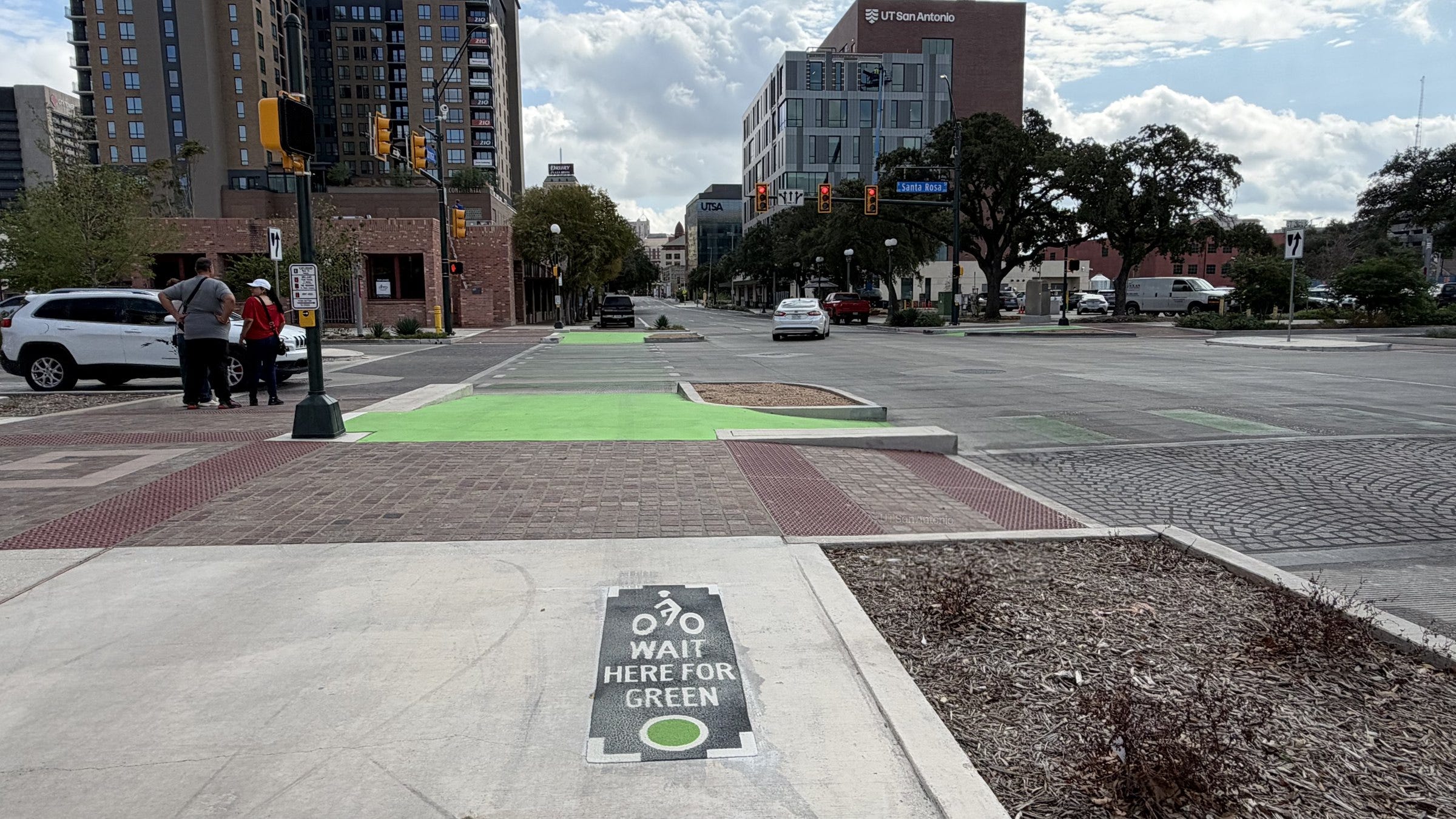
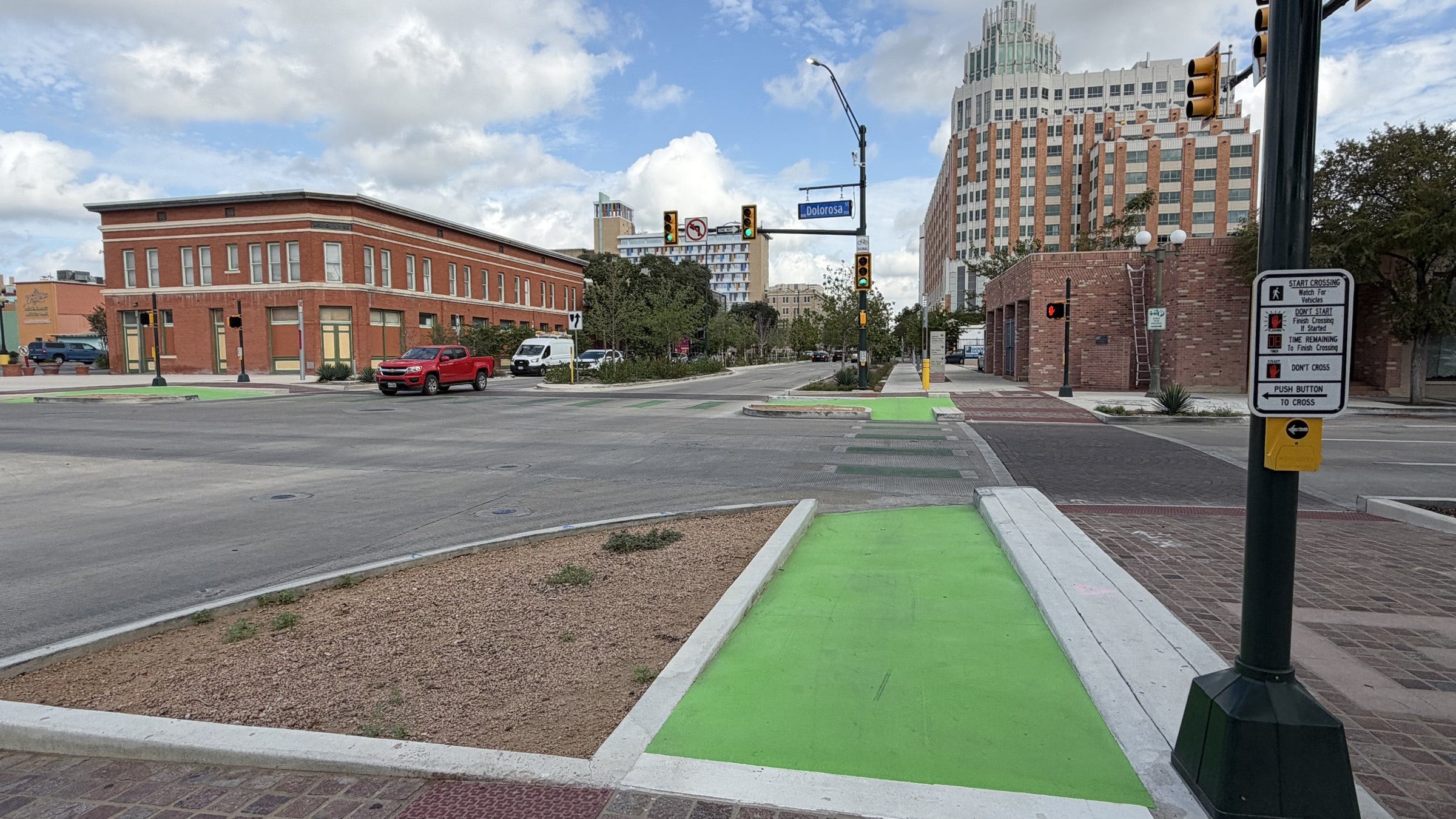
I was in the room at the April 2026 public meeting, and what struck me was how many supporters said the same thing: Market Street is not a comfortable place to ride today, but this project could transform how we move through our city. These same supporters saw it becoming a vital backbone of the citywide cycling network, one where our children, grandparents and people with mobility challenges can ride comfortably too.
The demand is already there. City data shows about 120 shared scooter and bike trips happen on Market Street every day, with nothing between riders and moving traffic. Many of those riders are service workers heading to a shift, students, or visitors who might be commuting from their hotel to a convention or catching dinner at one of our amazing local restaurants.
The stakes are real. In San Antonio, people walking and biking make up under 6% of injury crashes, but about 28% of the crashes that seriously injure or kill.
For many of our neighbors, a bike is not a hobby. It is how they get to work and get around in their daily life. Citywide, 85% of San Antonians living below the poverty line can’t reach a health center within a 15-minute bike ride. Downtown is also where many of them work, in hotels, restaurants and offices, often on early or late shifts. This corridor links the West Side and East Side directly to those jobs. That’s what transportation equity looks like: a safe, direct route from our neighborhoods to the places people need to go.
The current project took shape when the City’s Public Works team revived the idea, after it became clear Commerce Street through downtown would not get bike lanes. Market Street was chosen because it is direct and its width stays consistent end to end.
The project first won regional funding in 2021 through the Alamo Area Metropolitan Planning Organization’s (AAMPO) 2020–2026 Transportation Improvement Program, as an unprotected lane running from I-35 to I-37. Downtown’s Houston Street TIRZ was proposed to cover the 20% local match, which would also have carried the lane west to Frio Street to meet the West Side bike lanes on Buena Vista and Commerce. Then the City won a competitive TxDOT Transportation Alternatives grant of about $15.85 million in 2023, which replaced AAMPO’s funding and was enough to make the lane fully protected. The City’s share is about $1.89 million, out of $17.74 million total. But today’s version starts at Flores Street, and the final link to the West Side is still unbuilt. Finishing that link to Frio Street should be the City’s next priority, so the cycle track connects West Side neighborhoods to downtown instead of becoming another isolated segment.
That grant is not a blank check. TxDOT has confirmed these funds generally cannot be moved to another corridor.
If we walk away, that money does not become sidewalks somewhere else downtown. It goes to another Texas city, and cyclists lose the spine downtown sorely needs.
I have heard the worries about traffic, deliveries and big events. They deserve answers, not dismissal.
Downtown streets fill up during conventions, parades and playoff nights, and more car lanes have never fixed that anywhere. Streets aren’t measured by how many cars they carry, but by how many people they move. A protected bike lane and a dedicated bus lane can carry far more people than a car lane in the same space, and that’s how great downtowns handle a crowd.
Deliveries to local businesses matter too, and they deserve a real plan. Downtown business owners have described vendors parking on Market Street and simply paying the ticket when a loading bay is full. That isn’t a bike lane problem. It’s a sign the curb isn’t working today, and this project is the chance to fix it.
Downtown San Antonio needs a comprehensive curbside management plan that balances loading zones, delivery windows, passenger pick-up, ride-hail and bike lanes, working together instead of competing. The Alamo Area Metropolitan Planning Organization plans to fund a $150,000 regional curb management study in fiscal year 2027, and Market Street should be one of its first priorities. But the City shouldn’t wait. For Market Street, the work can start now with a loading study, done before the design is final, to find where demand is greatest, then strategically designated loading zones for every block: on cross streets, in sidewalk loading pockets where space allows, and through partnerships with hotels, garages and businesses that already have off-street loading areas. Driveways into those lots and docks should keep safe, clearly marked access across the cycle track. Early-morning delivery windows can keep most loading out of peak hours, and enforcement has to keep those zones clear for the businesses that depend on them.
Other cities show this works. Pittsburgh’s smart loading zones, which drivers reserve and pay for by the minute, cut double parking by 40% in their first year, and the city has since grown the program from 20 to 75 locations. In Washington, D.C., a pilot that turned metered spaces into reservable loading zones cut double parking by 64%, according to preliminary results.
Downtown stakeholders also deserve a clear construction-access plan so businesses keep deliveries and customers flowing while the project is built.
Transit planners have already done their homework. VIA’s federal environmental review for the Silver Line, required under the National Environmental Policy Act, included the Market Street Cycle Track in its analysis.
People on bikes and scooters are like everyone else: they take the most direct route to where they’re going. That’s why so many already ride Market Street, even with no protection. Bike lanes belong where people are already riding. San Antonio needs clear, direct and protected bike infrastructure that connects people to the places they want to go.
Imagine what that could look like. A delivery driver who knows exactly where to stop. A hotel worker who can bike to her shift without bracing for every passing truck. A family riding from the West Side to Hemisfair on a Saturday morning. A student commuting from the East Side to UT San Antonio’s College of AI, Cyber and Computing.
That is why 13 local organizations, from Bike San Antonio to disABILITYsa to Strong Towns San Antonio, signed a letter with ActivateSA backing this project. We also asked the City to get the details right: An extension west to Frio Street to meet the West Side bike lanes, sturdy barriers and planters instead of flimsy posts, bike signals, no left turns on red, green markings at every intersection and most importantly, ensuring that this project creates a connection that is built for people of all ages and abilities.
I know not everyone will agree. Change on busy streets is hard, and the people who have built businesses downtown have earned a voice in how it changes. I hope they use it in the design process, at the table with riders, workers and the City.
We have the money. We have a design. What we need now is the will to finish it well.
We often speak of San Antonio striving to become a true world-class city. We’ve invested in a world-class airport terminal, a reimagined Hemisfair, and plans for a downtown sports and entertainment district.
But the world’s great cities aren’t defined only by their arenas and terminals; they’re defined by how people move through them.
It’s time we build transformational active transportation projects — like the Market Street Cycle Track — that propel us in that aspirational direction.
Citations
City Council Greenlights Bold Bike Network Plan, City of San Antonio, January 30, 2025.
San Antonio Bike Network Plan, Final Report, City of San Antonio.
PeopleForBikes City Ratings: San Antonio, TX, PeopleForBikes, 2025.
Rebooted bike plan wants to make car-centric San Antonio safer for cyclists, San Antonio Report, February 2, 2025.
San Antonio City Council approves a new bike network plan, Texas Public Radio, February 1, 2025.
San Antonio’s downtown in search of a new vision, San Antonio Report, July 24, 2022.
San Antonio to receive $16 million TxDOT grant for downtown bike lanes, City of San Antonio, November 21, 2023.
Market Street Cycle Track (South Flores to IH-37), SASpeakUp, City of San Antonio.
City of Pittsburgh Smart Loading Zones Case Study, Carnegie Mellon University Metro21, March 2023.
Smart loading zones help cities take back the curb, Smart Cities Dive, June 26, 2025.
CurbFlow pilot reduced double parking in DC by 64%, Smart Cities Dive, November 14, 2019.
THE VOICE:
Joey Pawlik

Joey Pawlik is executive director of ActivateSA, a San Antonio nonprofit advocating for trails, safe streets, and better multimodal transportation choices for all.