


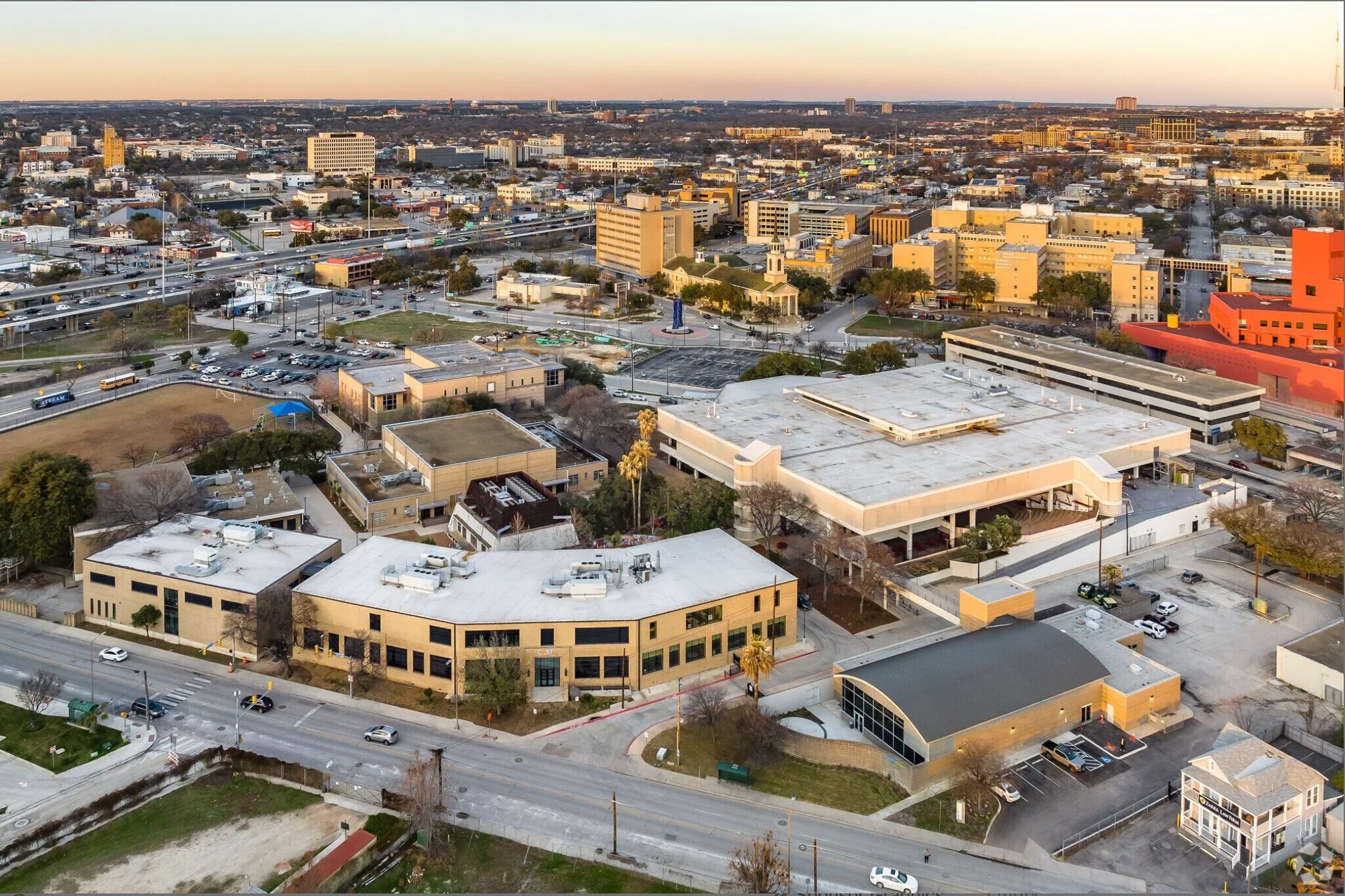
One decade ago, San Antonio’s original high school, the downtown Fox Tech (originally opened as Old Main High School in 1882) hit a historic low enrollment of 353 students.
Student enrollment had been falling from its high point in the mid 2000’s, when it served 1,700 students, rivaling San Antonio Independent School District’s largest high schools today. The decline had many causes, including a lack of housing downtown, a district decision to phase out athletics starting with football in 2009, and a refocusing of the school on a law and health magnet program in an attempt to attract new students. By 2013, enrollment had fallen to 444 students, and then to 379 in 2014.
When enrollment dropped to 353 in 2015, rumors circulated that the campus was unsustainable at that size, and might face closure.
2015 was also the year Superintendent Pedro Martinez arrived in San Antonio ISD. In August of 2016, he launched his first innovative school model, the Advanced Learning Academy (ALA), in partnership with Trinity University with financial support from City Education Partners.
ALA, the city’s first Pre-K-12 Academy, was spread across the Fox Tech campus and the nearby Austin Academy, and the district recruited Principal Kathy Bieser from the well-regarded International School of the Americas (ISA) to implement a project-based learning designed to foster interdisciplinary and higher-order thinking through hands-on projects. The school had a waiting list when it opened, and that has continued until today.
That same summer, Martinez joined business leaders and the tech advocacy group Tech Bloc to announce the creation of the district’s first career-themed high school, CAST Tech, which would occupy 2 abandoned buildings on the Fox Tech campus. Dr. Melissa Alcala, was recruited from the well-respected STEM Academy to act as the founding principal. Like with ALA, the initial response to the announcement was a surge of interest, and the school opened with a waiting list for its incoming class of 9th graders.
The 2 new school models shared a campus with the health and law magnets, and collectively breathed new life into this school. In 2018, the Texas Legislature passed a law allowing for partnerships with nonprofits, colleges or charter management organizations to create innovative schools and earn additional dollars for programming, and both CAST Tech and ALA joined a partnership with the CAST Schools nonprofit, of which I am the founding executive director. Alamo Colleges became the partner for the health and law programs, hiring Principal Jennifer Benavides from Dallas, and in 2019, the health program became a P-Tech school, a model that enabled students to complete an associate’s degree while on track to earn their RN.
Over the course of a single decade, the Tech campus transformed from a traditional high school to three popular innovative co-located small schools that shared newly invigorated athletic and fine arts programs. The campus never reinstated football, but its other sports teams restarted and are growingly competitive; their UIL theater program has won district competitions for multiple years, and continued to regional events, and the mariachi routinely is among the top in the state and this year earned a straight Division 1 rating. At the CAST Tech graduation this year, senior Madelynn Aparicio described how mariachi first taught her to push herself to be her best, and ultimately helped her see how to do so in a way that was focused not on individual but team success. “Not only is it hard to create a powerful community. But it is even more difficult to maintain it. It takes constant effort, trust, and selflessness. It’s built when we choose to actually support each other, rather than competing,” she said.
Like the phoenix rising from the ashes, the consolidated Tech campus (which includes ALA grades 4-12, CAST Tech, and Fox Tech health & law) is at capacity. It boasts a higher enrollment than all but three of the district’s comprehensive high schools. Within each of the three schools, young people can select a program of high interest, engage in career-connected learning, participate in internships and mentorship, and leave with both industry-based certifications and college credits.
These smaller, specialized campuses encourage students to ask these 4 questions (Ikigai):
What am I good at?
What am I passionate about?
What does the world need?
What can I get paid for?
Their smaller size allows them to build strong relationships with each other and their teachers, and they leave with a strong network of caring adults and a plan and a purpose, while still enjoying outstanding fine arts programs and athletics. Common elements across the 3 schools include:
Strong local homegrown partners (CAST Schools & Alamo Colleges) that remained stable even through changes in school district leadership
Strong core visions for each campus – defining principles and values, consistent throughout COVID and other disruptions
Strong founding principals recruited from outside San Antonio ISD
These schools were built to ensure that students are ready to go straight into the workforce should they not go straight to college. Despite that, the majority of students at these three schools, where they have had a taste of college success, immediately enroll in college: on average 77% from ALA, 71% from CAST Tech, and 69% from Fox Tech. In comparison, the top performing traditional high school in San Antonio ISD sends 54% of its graduates immediately to college; the district’s average is significantly lower.
What if the future of traditional high schools looked a lot less like places where principals and teachers couldn’t possibly know every one of their students and looked a lot more like San Antonio’s very first high school, the reimagined Tech?
THE VOICE:
Jeanne Russell

Jeanne Russell spearheaded the creation and design of signature San Antonio initiatives at the intersection of education and workforce, such as Café College, PreK4SA and SA Works. She is the founding executive director of CAST Schools, a nonprofit school network dedicated to economic mobility and nurturing San Antonio’s homegrown talent. Co-created in 2018 as a regional partnership between independent school districts, higher education institutions, and local employers, CAST offers a new model of teaching and learning alongside industry professionals committed to connecting students with high-demand, high-growth, high wage jobs. The network has grown to 7 innovative and nationally-recognized career-connected schools in 4 San Antonio school districts. She began her career as a middle and high school teacher in East Harlem, Tokyo and Guatemala, and that experience taught her the value of listening to students, engaging them in classroom and school design, and never underestimating their talents. She spent a decade as a reporter and editor examining education before joining two San Antonio Mayors to craft their education policy agendas. Her opinions do not reflect the considered opinions of CAST Schools, but are hers alone.