


Each year, the Texas Education Agency rates each school from A to F. This rating-based accountability system considers not only achievement, but student growth and how well schools are closing gaps.
For years, conversations about school quality in San Antonio have too often focused on what is not working.
This year’s data gives us reason to tell a more complicated, and more hopeful, story.
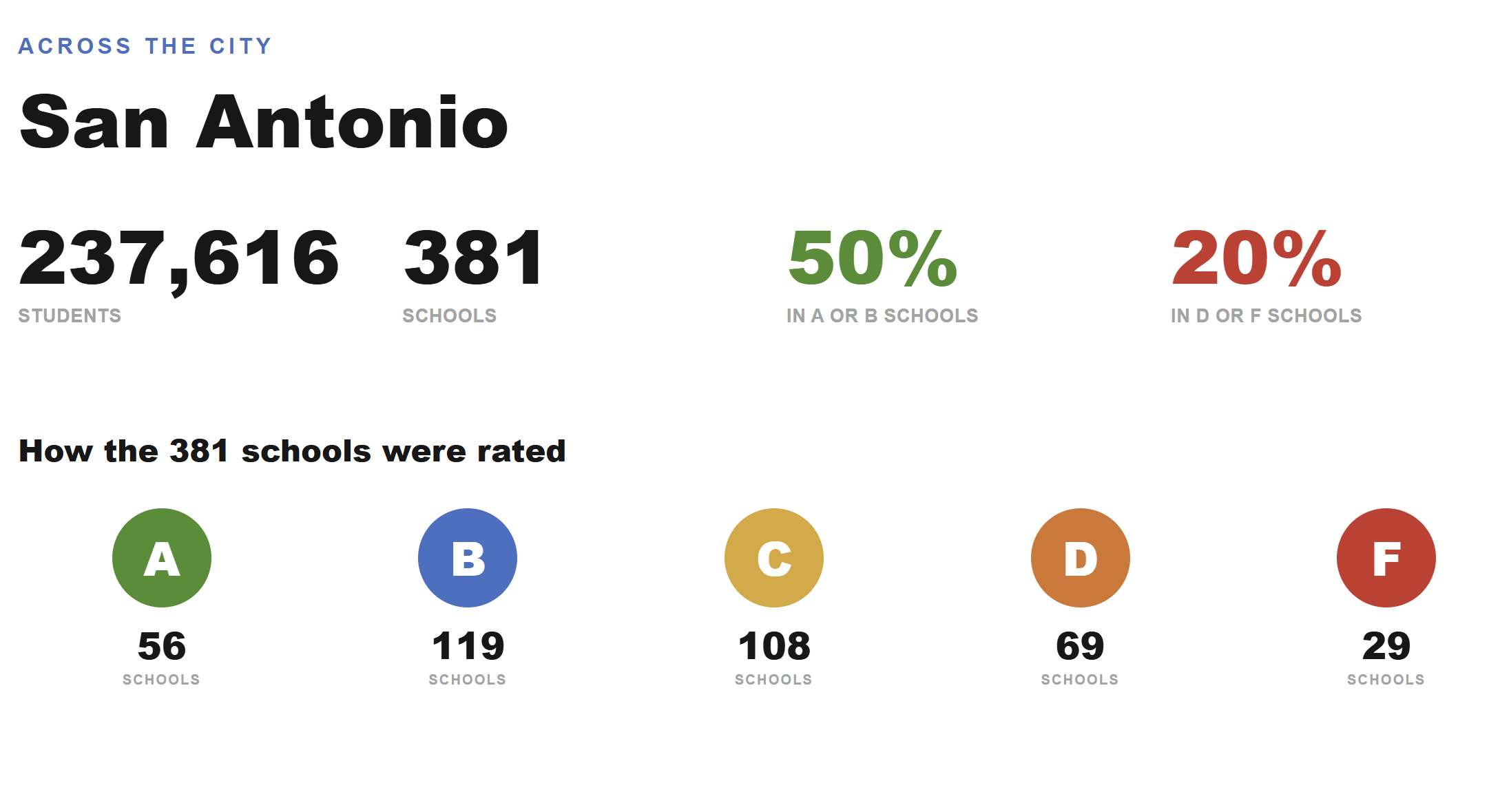
San Antonio schools are progressing. In the 2025-2026 school year, 50% of San Antonio students attended A or B schools, compared to 39% during the 2022-2023 school year. We also saw a decrease from 34% of students in D or F schools to 20% over the past four years.
We are seeing schools make dramatic turnarounds, entire school systems move into stronger performance, and campuses demonstrate that strong accountability ratings and strong student learning can exist together.
That progress deserves recognition. But it should also make us curious.
The most important question now is not simply whether a school moved from an F to a B. It is what changed to make that improvement possible and how we make it happen for more children.
That is one reason City Education Partners created the San Antonio School Quality Explorer, an interactive tool for navigating and understanding this data, accompanied by video tutorials and suggestions for the questions you should be asking about the data and to whom you should be directing those questions. We hope that giving families, educators and civic leaders this tool empowers them to look beyond a single letter grade and see how school performance is changing across our city.
And when you look closely, one thing becomes clear: progress does not look the same everywhere.
Some campuses have experienced dramatic transformation. Pershing Elementary and Mead Elementary, for example, moved from F to B ratings.
Other school systems are more steadily crossing into stronger levels of performance. North East ISD, Southside ISD, Legacy Traditional and Somerset Academies moved from C to B.
Where a child lives still has a significant relationship to the school options available to them.
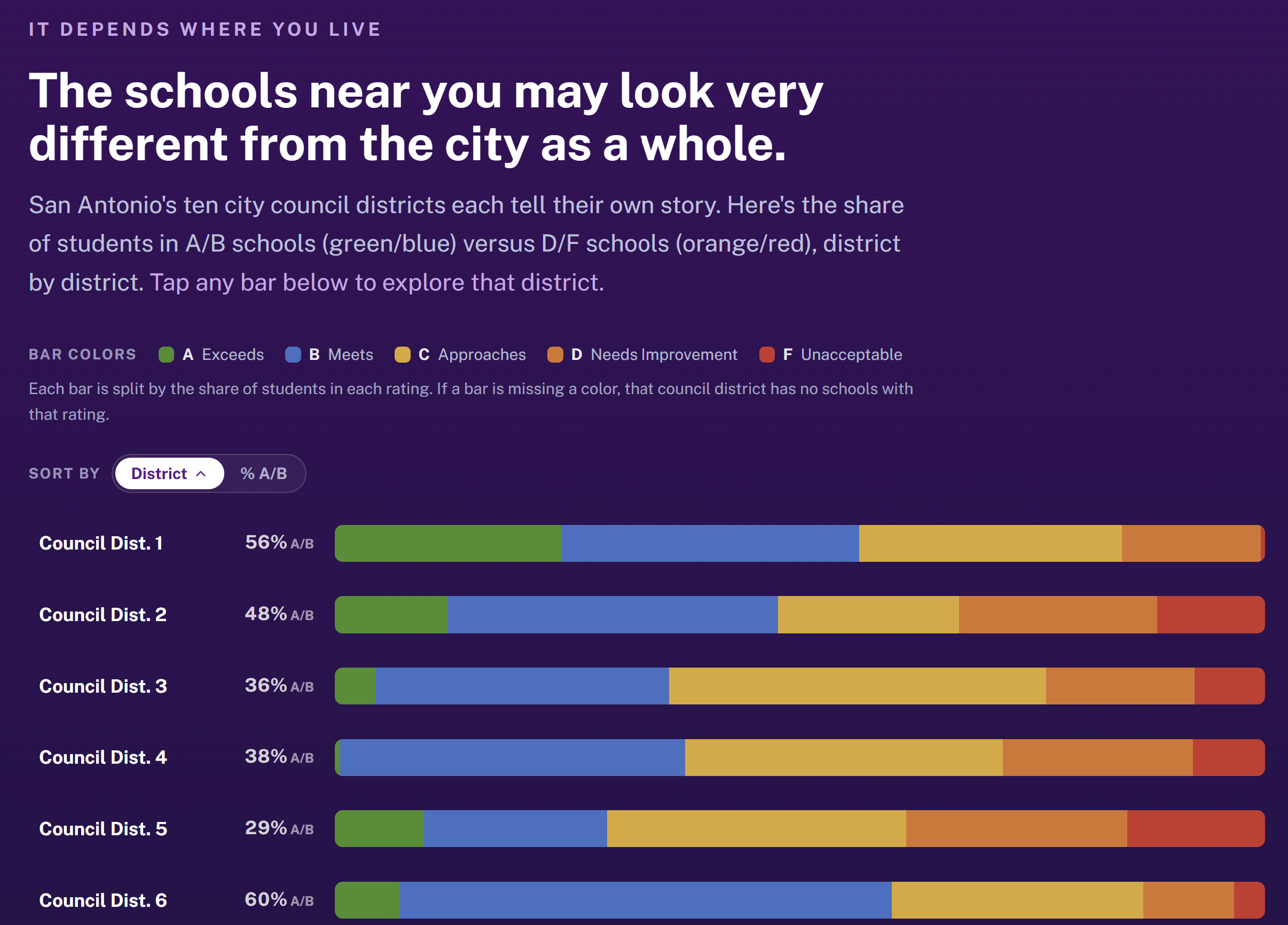
In City Council District 9, 88% of students attend A- or B-rated schools. In District 8, it is 73%. Compare that with 29% in District 5, 30% in District 7, 36% in District 3 and 38% in District 4.
We see a similar pattern when we look at Loop 410. Outside the Loop, 61% of students attend A- or B-rated schools, compared to just 39% of students inside the Loop.
Citywide averages can improve while too many families still experience something very different in their own neighborhood. Real progress will mean that a child’s ZIP code becomes less predictive of whether they can access a strong school.
The most hopeful lesson in this year’s data is simple: school performance is not fixed.
In just one year, District 6 increased the share of students attending A- or B-rated schools from 40% to 60%. Districts 1 and 2 each gained 19 percentage points, while District 4 increased by 12 points.
Schools can change. Systems can improve. Students who have historically had too little access to strong schools can experience something better.
Now San Antonio needs to understand how. And we should resist the temptation to assume that one type of school holds the answer.
Today, 65% of San Antonio public charter students attend A or B rated schools, compared with 47% of students in traditional ISDs. But strong performers, dramatic turnarounds and schools building momentum exist across both sectors. That should push us toward learning across school models rather than arguing that any particular structure guarantees success.
When a campus moves from F to B, we should ask what leaders, teachers and families did differently. When an entire system begins to move, we should understand the conditions that support it. When progress is not reaching a neighborhood or a group of students, we should be just as willing to look directly at that reality.
That is what we hope the San Antonio School Quality Explorer makes easier: not simply seeing who earned which letter, but following the trajectories, identifying the bright spots and confronting the places where improvement has not yet reached enough children.
San Antonio schools are moving. Now the challenge is to learn from one another, collaborate on what is working for kids, and turn that momentum into something much bigger: sustained improvement, deeper student learning, and strong schools within reach of every child in our city.
THE VOICE:
Dalia Flores Contreras

Dalia Flores Contreras is the Chief Executive Officer of City Education Partners (CEP), a San Antonio–based nonprofit ensuring every student has access to a world-class education, no matter where they live. Under her leadership, CEP has invested more than $30 million to launch and expand high-quality schools, grow teacher and leader pipelines, and strengthen family and community advocacy.
A proud San Antonio native, Dalia brings over 20 years of experience in education across Texas, Illinois, and Oklahoma—spanning roles as classroom teacher, principal, superintendent, and senior district executive in both district and charter systems. Her path from first-generation college student at Palo Alto College and The University of Texas at San Antonio (B.A. Interdisciplinary Studies, M.A. Educational Leadership & Policy Studies) to nationally recognized education leader fuels her commitment to excellence and opportunity for all students.
Since becoming CEP’s CEO in 2021, Dalia has led the organization to:
Expand impact citywide—partnering with schools serving over 20,000 students to improve outcomes and access.
Attract national investment—leveraging a 7:1 fundraising record to bring significant new resources into San Antonio.
Fuel innovation—from launching teacher preparation pipelines to seeding new school models aligned with workforce needs.
Widely regarded for her strategic foresight and ability to unite diverse partners, Dalia navigates complex policy, funding, and community landscapes with clarity and purpose. Her leadership blends urgency with optimism, ensuring the work delivers lasting change for students and families.