


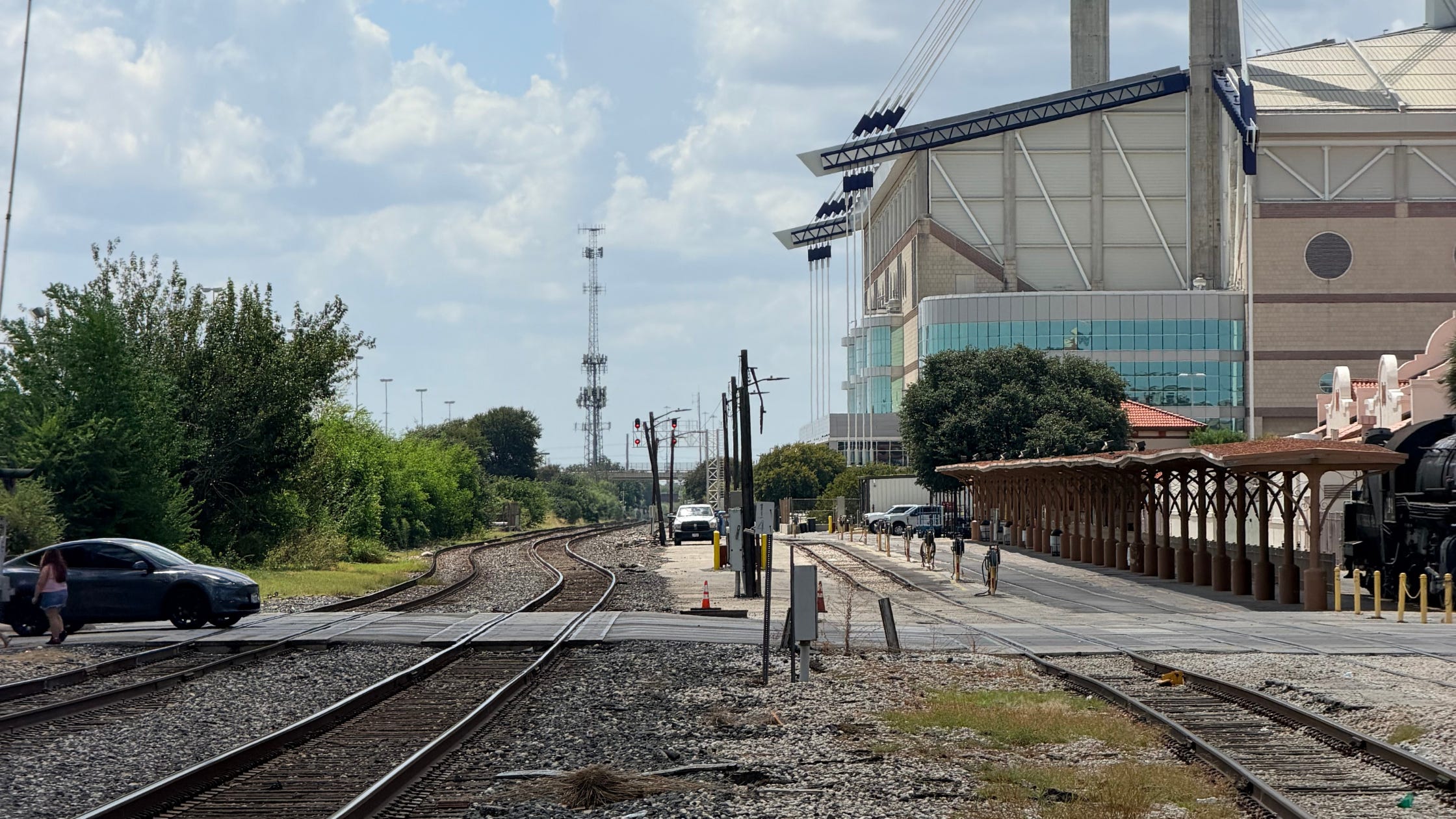
A former teammate of mine and I used to have a little Texas fantasy.
We were both urban nerds, the kind of people who could spend way too much time talking about downtowns, sidewalks, transportation and why cities work the way they do. Every once in a while, we would wish out loud for the same thing: Wouldn’t it be nice if, before we retire, we could wake up in San Antonio, get on a train to Austin, have lunch, take a meeting or two, and be back home that evening?
That’s it. Not a bullet train across Texas. Not some European transportation utopia. Just San Antonio to Austin. For years, it has felt less like an infrastructure project and more like a wistful little fantasy between two urban nerds.
Then my good friend Beto Altamirano literally got on the train.
Beto, CEO of Tech Bloc, recently produced a terrific three-part Instagram series about passenger rail between San Antonio and Austin. You should watch all three. What I loved about the series is that he didn’t stand in front of a map and tell us why trains are great. He got on and rode it.
You can board Amtrak’s Texas Eagle in San Antonio early in the morning and ride it to Austin. Beto’s ticket cost $17. The seat is big. You can work. You can watch the country go by. Most importantly, you don’t have to spend your morning staring at brake lights and 18-wheelers on I-35.
It sounds great, except for one fairly important problem: You can’t really use it for a normal day in Austin. There is one train a day in each direction, and it arrives on schedule 56 percent of the time. One daily train that shows up late almost half the time isn’t a commute. It’s an adventure.
Think about that. We have a train between San Antonio and Austin. We just don’t have one that functions like transportation for most people.
Texas has tried versions of this idea for decades, most recently by studying whether passenger trains could share Union Pacific’s existing freight corridor. Union Pacific says the corridor is not sufficient to handle both freight and passenger demand, so Travis County studied another option: build a separate route.
The $13.5 billion number
The alternative would create roughly 90 miles of new passenger rail between Austin and San Antonio, much of it following SH 130 and I-10.
Estimated cost: $13.5 billion.
When I first saw that number, I had roughly the same reaction I imagine most people did. Well, there goes the train. Thirteen and a half billion dollars is an absurd amount of money. That’s fantasy money.
Then I started wondering about something: What does a highway cost?
Right now, TxDOT is expanding approximately 20 miles of I-35 on the northeast side of San Antonio. TxDOT now puts the total program at about $3.5 billion. Do the math and that’s roughly $175 million per mile.
Now apply that same cost to 90 miles.
$15.75 billion.
The proposed 90-mile train?
$13.5 billion.
Suddenly, the fantasy doesn’t sound quite so fantastical.
This isn’t an apples-to-apples engineering comparison. The I-35 expansion is a complicated project, and highway costs vary enormously. I’m not suggesting a new 90-mile freeway would cost $15.75 billion. The point is simpler: Texas already spends transportation money at this scale.
And if $175 million per mile sounds shocking, look 80 miles north. TxDOT is reconstructing approximately eight miles of I-35 through central Austin at an anticipated construction cost of about $4.5 billion.
Eight miles. $4.5 billion.
We hear numbers like that around highways and somehow they have become normal. We debate the design, complain about construction and wonder how many years it will take. But very few people look at a multibillion-dollar highway expansion and declare that the entire concept of highways is financially impossible.
What counts as normal?
Tell Texans we’re going to spend billions expanding an interstate and the conversation usually starts with when construction begins. Tell Texans we’re going to spend billions on passenger rail and suddenly everybody becomes an accountant.
We should ask hard questions about rail: How many people will ride it? How often will it run? What will it cost to operate? Where will the money come from? Rail should answer every one of them. So should highways. They are staggeringly expensive pieces of public infrastructure, and we almost never make them prove it.
For me, this stopped being an argument about transportation a long time ago.
The ASA Region
The older I get, the more I realize this train isn’t really about my friend and me getting lunch in Austin.
It’s about opportunity.
I first started thinking this way years ago when I read Richard Florida’s Who’s Your City? Florida wrote about the rise of megaregions, including a Texas megaregion connecting Dallas, Austin and San Antonio. The idea stuck with me.
More recently, Henry Cisneros, Bob Rivard and David Hendricks brought the concept directly home in their book The Austin-San Antonio Megaregion: Opportunity and Challenge in the Lone Star State. Their premise is essentially that this region is already emerging, and our challenge is whether the infrastructure, housing, workforce and leadership can keep up with it.
I’ve started thinking of it simply as the ASA Region: Austin-San Antonio.
And here’s why that matters to me.
Austin has something San Antonio desperately needs more of: high-wage jobs. The latest federal wage data show the average hourly wage in the Austin metro is roughly 22 percent higher than in San Antonio. Austin also has deep concentrations of technology and professional jobs that San Antonio has spent years trying to attract.
San Antonio has something Austin increasingly needs: affordability. Recent housing data put Austin’s median home sale price at about $562,000 against San Antonio’s $268,000.
Think about the economic opportunity sitting between those two facts.
A San Antonian shouldn’t necessarily have to move to Austin to gain access to an Austin paycheck. An Austin worker shouldn’t necessarily have to leave an Austin career to find a place they can afford. A student at Texas State in San Marcos, sitting right between the two, should be able to reach an internship in either city. A company choosing where to locate should be able to think about the talent of an entire corridor instead of one isolated labor market.
No train solves all of that on its own. Stations matter. Local transit matters. Schedules matter. Not every job suddenly becomes commutable. But real passenger rail changes the possibilities. It connects workers to jobs, companies to talent, and students to both. It gives people living between our two cities more choices without forcing every one of those choices onto I-35.
That’s not a train fantasy. That’s economic development.
The ASA Region is going to continue growing whether we build the train or not. San Antonio, New Braunfels, San Marcos, Kyle and Austin aren’t moving farther apart. They’re growing toward one another. The question is whether we build the infrastructure that allows that growth to become an economic advantage, or whether our vision of a megaregion is simply millions more people sitting in traffic together.
For years, civic leaders have talked about the Austin-San Antonio corridor as one of the great economic opportunities in Texas. At some point our infrastructure has to catch up with the rhetoric.
I don’t know which rail proposal ultimately wins. Maybe we find a way to work with Union Pacific. Maybe we have to build around them and start smaller than anything on the table right now.
What I’m increasingly convinced of is this: the reason we don’t have a train is not that the numbers are unimaginable. We imagine numbers like this all the time. We just usually imagine them with concrete, frontage roads and another lane of traffic.
Maybe my old teammate and I weren’t fantasizing about something impossible. Maybe we were just seeing a little early what this region was going to become.
I’d still like to do it before we retire.
San Antonio in the morning. Lunch in Austin. Home for dinner.
Let’s build the train.
Citations
KUT 90.5, Nathan Bernier, “Studies say Austin-San Antonio passenger rail requires $13 billion or a route Union Pacific resists,” August 20, 2026. Source for the roughly 90-mile alternative route, the $13.5 billion cost estimate, the current Amtrak schedule and its on-time performance, TxDOT’s passenger rail study, Union Pacific’s position and the alternatives under consideration.
Texas Department of Transportation, I-35 Northeast Expansion Program. TxDOT describes the I-35 NEX program as an approximately 20-mile expansion through Bexar, Comal and Guadalupe counties.
Texas Department of Transportation, San Antonio District Profile, revised March 19, 2026. TxDOT describes the I-35 Northeast Expansion as a $3.5 billion investment to improve I-35 from N. Walters Street to FM 1103. The $15.75 billion figure in this article is a simple extrapolation of that cost across 90 miles, not a TxDOT estimate for a 90-mile highway.
Texas Department of Transportation, I-35 Capital Express FAQs. TxDOT states that construction of the Central project is anticipated to cost approximately $4.5 billion. The project’s length, an 8-mile stretch of I-35 from U.S. 290 East to Ben White Boulevard, is reported by KUT 90.5, Nathan Bernier, “Your ultimate guide to the I-35 expansion through Central Austin,” February 21, 2024.
U.S. Bureau of Labor Statistics, Occupational Employment and Wages in Austin-Round Rock-San Marcos, released August 13, 2026. BLS reports an average hourly wage of $35.85 across all occupations in the Austin metropolitan area, reference period May 2025.
U.S. Bureau of Labor Statistics, Occupational Employment and Wages in San Antonio-New Braunfels, released August 13, 2026. BLS reports an average hourly wage of $29.39 across all occupations in the San Antonio metropolitan area, reference period May 2025. Compared with Austin’s $35.85 figure, Austin’s average hourly wage is approximately 22 percent higher.
Redfin housing market data for Austin and San Antonio. Figures are for the three months ending July 2026: Austin’s median home sale price about $562,000 and San Antonio’s about $268,000, a ratio of roughly 2.1 to 1. City figures, not metro. Redfin updates these pages continuously, so the live numbers will have moved since publication. As of the August 2026 update they were $549,636 and $264,825, a ratio of 2.08 to 1.
Richard Florida, Who’s Your City?, megaregion analysis. Florida identified a Texas megaregion, which he calls Dal-Austin, encompassing Dallas, Austin and San Antonio, as part of his broader argument that interconnected metropolitan areas increasingly function as larger economic units. List summarized in CBS News, “Who’s Your City: Top 10 Megaregions.”
Henry Cisneros, Robert Rivard and David Hendricks, The Austin-San Antonio Megaregion: Opportunity and Challenge in the Lone Star State, Texas A&M University Press, 2025. The book examines the growing economic integration of Austin and San Antonio and the infrastructure, workforce, housing and planning challenges of the emerging megaregion.
Beto Altamirano, three-part Instagram series on Austin-San Antonio passenger rail, 2026. Source for the opening train journey and the inspiration for this article. Part 1.
THE VOICE:
Lorenzo Gomez III

Lorenzo Gomez III is a community builder, author, and public speaker who draws from his personal and professional experiences to inspire others. A former director at Rackspace Technology, Gomez is a key player in the development of San Antonio’s downtown entrepreneurial ecosystem. During Gomez’s four years as chairman and CEO of Geekdom, San Antonio’s premier collaborative startup community, Geekdom companies raised more than $422M in funding and its startups have created 2,489 jobs. A trusted advisor to Graham Weston, co-founder of Rackspace Technology, Gomez helped shape Weston’s 80|20 Foundation, which invests in San Antonio’s future by issuing grants to public charities that attract, grow, and retain San Antonio’s future workforce and job-creating entrepreneurs. Gomez has authored four books: Cilantro Diaries, Tafolla Toro, The Rack We Built, and The Bully in Your Pocket. All four are Amazon best sellers and two are winners of the 2021 International Latino Book Awards. Lorenzo’s driving passion is his love for his hometown, San Antonio, Texas. His goal is to recreate for every San Antonian the opportunities the startup world has provided him in this city on the rise.