



Growing up, I didn’t think big.
I think a lot of us in San Antonio carry that, whether we realize it or not. I grew up in an inner-city neighborhood where most of my world existed within about a five-block radius. I didn’t get on a plane until I was 18. My life felt small, and if I’m being honest, I thought the city did too.
It felt like the bold, ambitious ideas you’d hear about in other cities weren’t something we did here.
My view of the city started changing in moments.
At Rackspace, I remember thinking how wild it was that a company would buy a struggling mall and turn it into its headquarters. That was bold. Then I watched Mayor Julián Castro launch the Decade of Downtown, reframing how the city thought about its urban core. Then Nelson Wolff and the Mission Reach, turning something overlooked into something transformative.
Those moments forced me to reconsider something I had believed for a long time.
San Antonio has always had people willing to think big. The River Walk was a big idea. Hemisfair was a big idea. The Pearl was a big idea. These weren’t incremental decisions, they were bets on a different version of the city. What I had mistaken for a lack of ambition was really a lack of continuity. Big ideas existed here, but they often felt isolated instead of part of a larger pattern.
Once you start connecting those moments, you realize San Antonio has been capable of big thinking for a long time. We just haven’t always seen those moments as part of the same story.
Which is why, when I sat down recently with Taylor Eighmy and Beto Altamirano for a conversation on Cilantro Diaries, I couldn’t help but feel like we might be stepping into another one of those moments.
The Scale of What’s Happening
There’s a moment early in our conversation that stuck with me. Taylor talked about a past conversation around potentially selling the downtown campus. The logic was simple: it wasn’t fully activated, it felt disconnected, maybe even unnecessary. Taylor’s response was direct. No. He believed downtown wasn’t something to retreat from, it was something to double down on.
That decision tells you everything about what’s happening right now. Because instead of shrinking, UT San Antonio is expanding in ways that would have felt unthinkable a decade ago.
Today, the university represents roughly 44,000 students, 17,000 employees, and a $2.8 billion enterprise footprint. It generates an $8 billion annual economic impact, conducts over half a billion dollars in research each year, and supports nearly 3 million patient visits annually through its health system.
And then there’s the merger.
The combination with the Health Science Center isn’t just another administrative move, it’s the largest academic merger in the history of higher education in the United States. In a city that often questions whether it can take on bold ideas, one of the boldest institutional decisions in the country just happened here.
What stood out most to me was how boldly Taylor framed it. “One plus one equals ten” wasn’t just about growth, it was about building what he called a “wildly audacious, world-class university.”
That ambition is backed by credibility. UT San Antonio now holds three major Carnegie designations: R1 research status, Opportunity University, and Community Engaged University. Only a small number of universities in the country hold all three.
Where Big Takes Shape
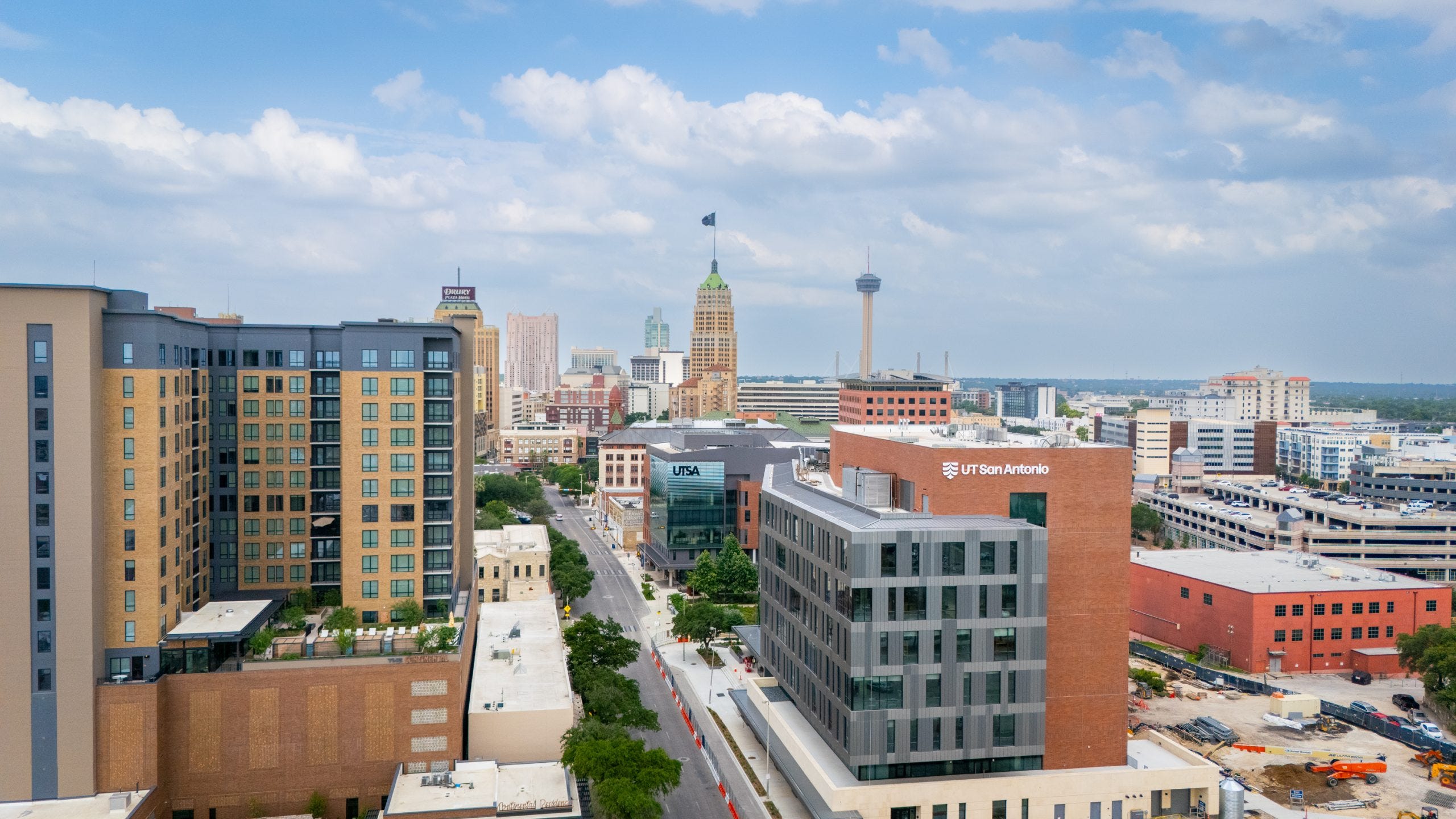
If the merger represents the intellectual shift, downtown is where people will begin to feel it.
UT San Antonio has invested nearly 400 million dollars into the urban core, acquiring land, repurposing buildings, and building new colleges with a clear goal: bring 10,000 students downtown.
That number matters because of what it produces. Ten thousand students means crowded coffee shops, more housing demand, more transit demand, and energy spilling into the streets around them. It creates a downtown that feels lived in, not just visited.
For years, we’ve talked about activating downtown and making it feel like a true urban core. Students are one of the most reliable ways to do that, and we’re about to see that happen at scale.
But here’s what really reframed it for me.
San Antonio already has roughly 160,000 students across its colleges and universities, more than Boston, yet you wouldn’t know it walking through downtown.
The issue has never been talent or capacity, it’s been concentration and visibility.
What’s happening now is the result of those pieces finally coming together in a way people can see, recognize, and respond to.
The Shift and the Stakes
This is where San Antonio has historically hesitated. We hear the word big and associate it with risk, cost, and the possibility of failure. But underneath that, there’s another tension.
For a long time, we’ve been a little afraid that getting big means trying to be something we’re not. That it means becoming Austin or New York or some version of a city that doesn’t quite fit who we are.
But that’s not what big means.
Big doesn’t mean becoming someone else. It means becoming a more complete, more scaled version of who we already are. And I’ll be honest, that’s something I didn’t fully believe earlier in my career. I thought there were limits to how far San Antonio could stretch without losing itself.
I’ve started to realize that isn’t true.
What I heard in this conversation wasn’t recklessness, it was discipline. A 10-year plan, targeted industry focus, alignment with workforce needs, and coordination across government, private sector, and philanthropy. This isn’t about chasing a moment, it’s about building an ecosystem.
Historically, San Antonio’s big ideas felt like exceptions. Now they’re starting to feel connected. The university’s growth, downtown development, emerging industries, and talent pipelines are beginning to move in the same direction.
And maybe that’s the real shift happening here.
Some of the most influential economies in the world were built around major institutions that helped shape the identity and trajectory of their cities. Stanford helped form the foundation of Silicon Valley. Not because anyone could predict exactly what it would become, but because talent, research, ambition, and investment started concentrating in the same place over time.
I’m not saying San Antonio becomes Silicon Valley. I think that misses the point entirely.
What I am saying is that UT San Antonio increasingly feels like the foundation of something bigger than itself. I don’t know exactly what that becomes yet. But for the first time in a long time, it feels like this city is building toward something at scale instead of reacting to growth around it.
Maybe the biggest shift is that San Antonio is finally starting to believe it can grow without losing itself.
Citations
UT San Antonio merger, institutional scale, and economic impact:
UT San Antonio Newsroom
Carnegie classifications and Opportunity University designation:
Carnegie Classification of Institutions of Higher Education
Downtown campus investments and strategic growth initiatives:
UT San Antonio Downtown Campus
THE VOICE:
Lorenzo Gomez III

Lorenzo Gomez III is a community builder, author, and public speaker who draws from his personal and professional experiences to inspire others. A former director at Rackspace Technology, Gomez is a key player in the development of San Antonio’s downtown entrepreneurial ecosystem. During Gomez’s four years as chairman and CEO of Geekdom, San Antonio’s premier collaborative startup community, Geekdom companies raised more than $422M in funding and its startups have created 2,489 jobs. A trusted advisor to Graham Weston, co-founder of Rackspace Technology, Gomez helped shape Weston’s 80|20 Foundation, which invests in San Antonio’s future by issuing grants to public charities that attract, grow, and retain San Antonio’s future workforce and job-creating entrepreneurs. Gomez has authored four books: Cilantro Diaries, Tafolla Toro, The Rack We Built, and The Bully in Your Pocket. All four are Amazon best sellers and two are winners of the 2021 International Latino Book Awards. Lorenzo’s driving passion is his love for his hometown, San Antonio, Texas. His goal is to recreate for every San Antonian the opportunities the startup world has provided him in this city on the rise.