



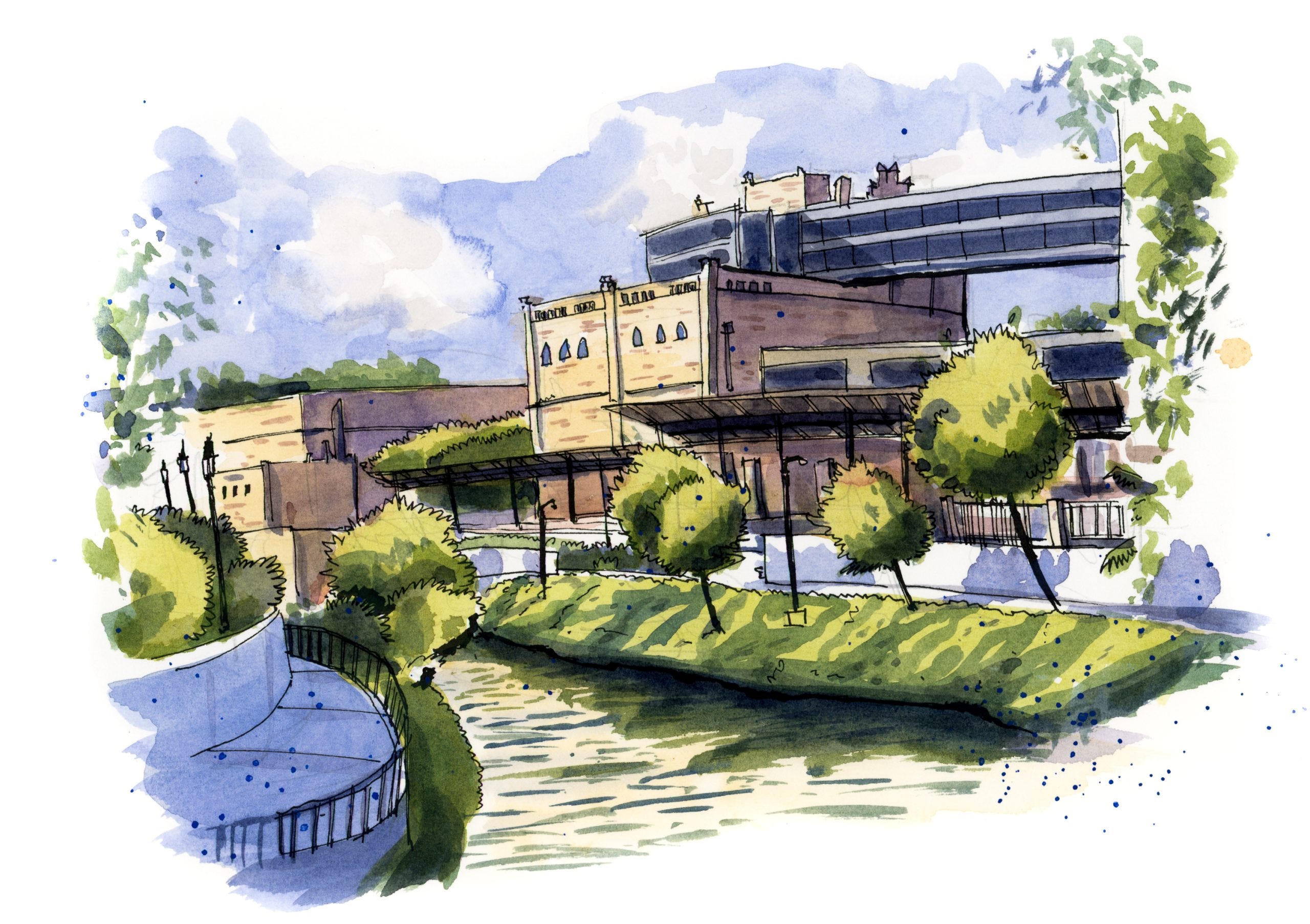
Article 3 of a four-part Urban Nerd series exploring the three distinct personalities of the San Antonio River Walk.
In 2017 I bought a house in Tobin Hill that I probably had no business buying.
It was rough, the kind of house where even the listing photos seemed to be warning you about the foundation. It needed work, a lot of work, and I remember my realtor trying to talk me out of it as he walked me through all the reasons why it might not be the smartest decision.
I told him something very clearly. The fact that I could walk to the Pearl Brewery from this house was worth $100,000 of quality of life to me. The fact that I could walk there for dinner, or lunch, or coffee, and walk back home, that was worth another $100,000.
Once I said that, the conversation changed because he understood what I was actually buying. I wasn’t just buying a house; I was buying proximity, and that decision changed how I experience the city and how I understand the river.
At the time, I thought I was buying a house near the Pearl, but what I was really buying was access to a different version of San Antonio.
That is why I call this stretch the Local’s River.
For this article, I am defining the Local’s River as the stretch that runs from the southern edge of Brackenridge Park, through the Pearl and River North, and toward the Thompson San Antonio Riverwalk, before the river fully becomes the Visitor’s River downtown.
I call it the Local’s River for two reasons: more people live along it, and more of daily life is possible on it.
That is the part I think matters most because this is not just a stretch of river with cool places nearby; it is the part of the River Walk where San Antonio is building the strongest argument for urban living.
Walk from the Pearl toward River North and you can feel it before anyone shows you a spreadsheet. There are apartments, balconies, dogs, strollers, joggers, lunch crowds, people taking calls, people carrying coffee, people walking home from dinner, and people using the river as part of their ordinary routine.
That does not happen by accident because it happens when enough people live close to enough places that support daily life.
The Pearl helped create that pattern. It is more than a destination; it is an anchor, one of the most intentional urban developments in the country, built around food, culture, education, hospitality, and public space. The Culinary Institute of America campus trains the next generation of chefs right on the river. Hotel Emma, recognized with Michelin Keys and the first property in San Antonio to receive that distinction, helped set a new standard for hospitality in the city.
For this article, the most important thing about the Pearl is not only what it contains, but what it set in motion.
People wanted to be near it, so the neighborhood around it began to change. Apartments rose, shops opened, sidewalks filled, Tobin Hill became more tied into the river, and River North started to fill in. The river stopped feeling like something you visited occasionally and started becoming something people organized their daily lives around.
That residential wave is still building. Oxbow Development Group, the real estate arm connected to the Pearl, has added projects like the 262-unit Coopers Row and the 75-unit Coopers Row North, and is planning more apartments nearby. Headwall Investments has received approval for a Tobin Hill project that could bring 575 apartments, along with retail and office space, to land bordered by North St. Mary’s Street, East Euclid Avenue and East Park Avenue. Near the San Antonio Museum of Art, the McCombs family’s Museum Reach development could add 390 housing units as part of a larger mixed-use project. The Flats at River North already brought 283 rental units to Broadway.
That is why the phrase Local’s River matters. Visitors still come here, and the rest of the river still belongs to locals, but there is no other stretch of the River Walk where this much residential life is clustering this close to this many things to do.
Once people live there, the second part of the story begins because a neighborhood has to support daily life, and that is what this stretch does better than anywhere else on the river.
You can feel it in the rhythm of an ordinary day: coffee in the morning, lunch at Make Ready Market, a walk past the San Antonio Museum of Art, a dog beside you on the river path, dinner at the Pearl, a drink at Elsewhere, and a show at the Tobin. None of those things alone make a district, but together they create a way to live.
For a long time, San Antonio was a city that excelled at building destinations but struggled to connect them. We had incredible places, but they often stood alone because you drove to them, experienced them, and drove away.
That is not what is happening here because here, you can walk from coffee to a meeting to lunch to a museum to dinner to a drink without thinking about it. You run into people, build familiarity, and over time begin to feel something that is difficult to manufacture: you feel part of something.
Looking back, the clue was there before I even bought the house. When I toured it for the first time, there was a large framed photo hanging in the living room from a quinceañera, and I remember looking at it and immediately recognizing the backdrop because it had been taken at the Pearl Brewery.
You see that same pattern show up all along this stretch of the river if you are paying attention: graduation photos, engagement photos, quinceañera portraits, announcements, and wedding moments on the bridge. That is not tourism, but ownership, and it is what it looks like when a place becomes part of people’s lives instead of merely something they visit.
That is what makes this stretch so important because it is not just a great place to live; it is a bridge between what San Antonio has been and what it is becoming.
The Visitor’s River introduced the city to the world, and the Local’s River is teaching the city how to live in it.
And we are just getting started.
Citations
Pearl-area residential growth and Oxbow apartment projects:
San Antonio Express-News reporting on Oxbow projects around Pearl, including Coopers Row, Coopers Row North, The Mira, and other nearby residential projects.
Headwall Investments Tobin Hill residential project:
Connect CRE reporting on Headwall Investments’ approved 575-unit Tobin Hill project near North St. Mary’s Street, East Euclid Avenue, and East Park Avenue.
McCombs Museum Reach development near San Antonio Museum of Art:
San Antonio Report reporting on City Council approval for zoning that could allow 390 housing units near Jones Avenue and Camden Street.
McCombs demolition near San Antonio Museum of Art:
San Antonio Express-News reporting on McCombs Family Partners demolishing buildings near SAMA to make way for apartments, offices, shops, restaurants, and parking.
Flats at River North apartment count:
San Antonio Housing Trust project profile for the 283-unit Flats at River North at 1011 Broadway.
Pearl district planning and development recognition:
American Planning Association recognition of Pearl as one of its Great Neighborhoods.
THE VOICE:
Lorenzo Gomez III

Lorenzo Gomez III is a community builder, author, and public speaker who draws from his personal and professional experiences to inspire others. A former director at Rackspace Technology, Gomez is a key player in the development of San Antonio’s downtown entrepreneurial ecosystem. During Gomez’s four years as chairman and CEO of Geekdom, San Antonio’s premier collaborative startup community, Geekdom companies raised more than $422M in funding and its startups have created 2,489 jobs. A trusted advisor to Graham Weston, co-founder of Rackspace Technology, Gomez helped shape Weston’s 80|20 Foundation, which invests in San Antonio’s future by issuing grants to public charities that attract, grow, and retain San Antonio’s future workforce and job-creating entrepreneurs. Gomez has authored four books: Cilantro Diaries, Tafolla Toro, The Rack We Built, and The Bully in Your Pocket. All four are Amazon best sellers and two are winners of the 2021 International Latino Book Awards. Lorenzo’s driving passion is his love for his hometown, San Antonio, Texas. His goal is to recreate for every San Antonian the opportunities the startup world has provided him in this city on the rise.