




Many years ago, I got to work with an awesome organization called Venture for America. Its founder was a guy named Andrew Yang, who I got to know pretty well and who would later run for president and get famous for an idea called Universal Basic Income.
Although I still have mixed feelings about UBI, there is one number from those years that has never left me.
$400.
I’m not an economist. I’ve never played one on TV. But I know how to read a number that won’t leave me alone.
Back when Yang was running, the Federal Reserve found that roughly four in ten American adults couldn’t easily absorb a surprise $400 bill. They’d have to borrow it, float it on a credit card, sell something or just not pay it.
The number has gotten better since then, but not nearly enough. The Fed’s latest survey says 63 percent of American adults could cover a $400 emergency straight out of cash, savings or a card they could pay off that month. Which means 37 percent couldn’t.
There’s another number in that data, and it’s the one that stopped me. In an earlier Fed survey, only 46 percent of Hispanic adults could cover it the same way.
That means 54 percent could not.
San Antonio is roughly two-thirds Hispanic. Now let me be careful about what that number is and isn’t. The Fed surveyed the country, not our city. Nobody knocked on a door on the West Side to get it. But when you live in a city that looks like ours, a national number like that one isn’t background noise.
Think about what $400 actually is. It’s a car repair. It’s a trip to the emergency room. It’s the air conditioner deciding to die in the middle of a San Antonio August.
Four hundred dollars isn’t the line between fine and bankrupt. It’s a measure of something simpler than that. It’s breathing room. It’s the cushion, and I’ve been thinking a lot lately about what happens when everybody in town reaches into it at once.
The pileup
Everywhere I look in San Antonio, somebody official is asking us for a little more money.
City staff has proposed a property tax increase to help close a projected $158 million budget gap over the next two years. At 3.9 percent it is the largest increase allowed without sending the question to voters, and it would be the City’s first property tax rate increase in more than 30 years. On an average homestead, which is the government’s way of saying a house somebody actually lives in rather than one somebody owns to rent out, it works out to about another $49 a year.
Alamo Colleges is looking at its first tax rate increase since 2013. The San Antonio River Authority is looking at one too, its second in two years, most of it to pay for a new flood warning system. And SAWS is proposing a multiyear string of rate increases to pay for billions of dollars of water and sewer pipe.
Then there’s CPS Energy. Earlier this year, CPS discussed the possibility of an increase of up to 4 percent as it confronted a roughly $50 million budget shortfall. CPS ultimately did not request that increase, so it is important to be clear: it isn’t currently on the table.
But I want to put these numbers next to each other for a reason.
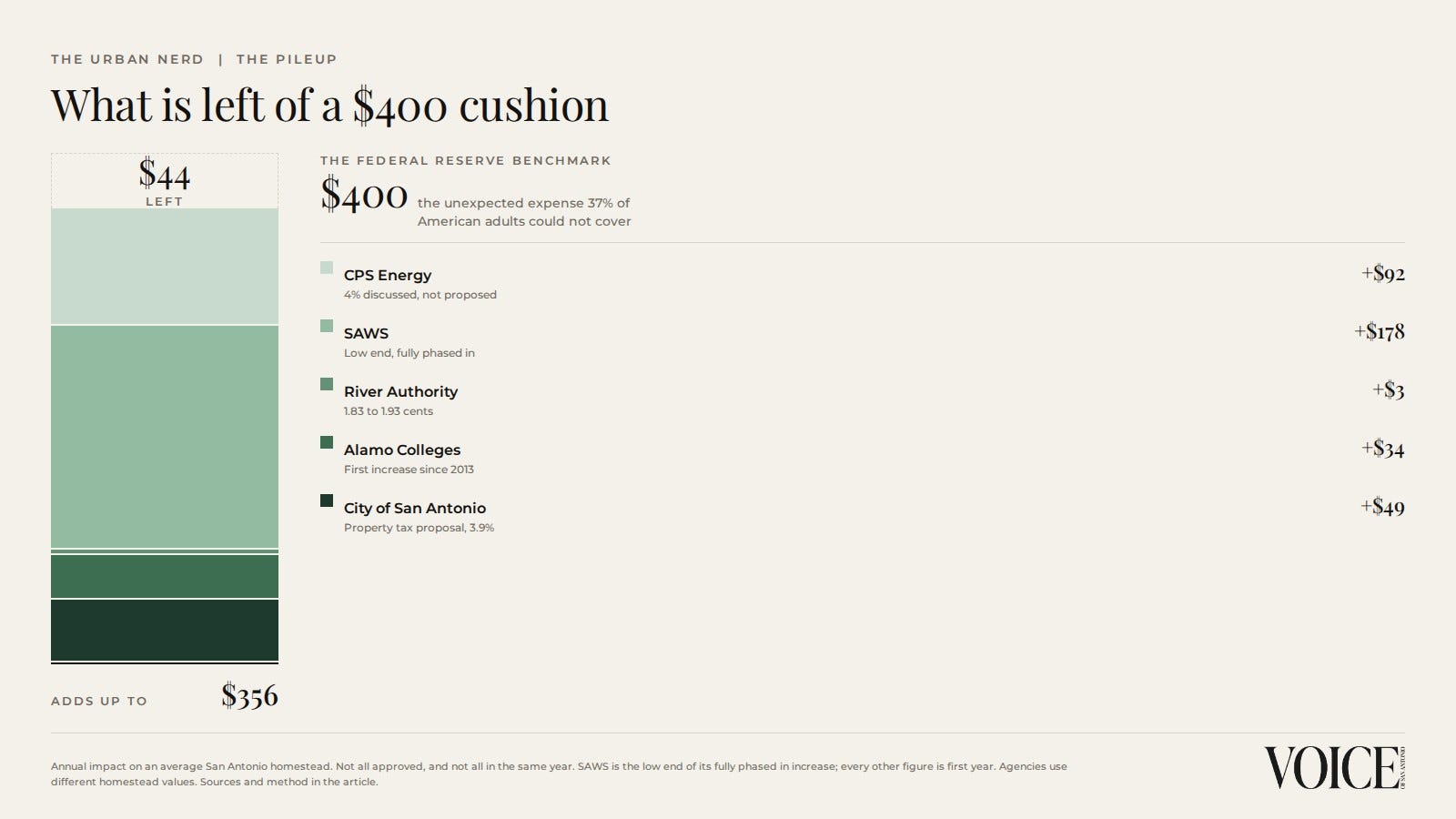
Before someone reaches for their calculator to write me an angry email, let me be clear about what this chart does and doesn’t say. These increases aren’t all happening tomorrow. Some haven’t been approved. CPS backed away from its contemplated increase. SAWS would phase in its increases over several years, and its figure here is the fully phased-in one while everything else is a first-year number. Each agency also calculates its impact against a slightly different home value. I’ve put the methodology and caveats in the Citations / Appendix below.
But that’s exactly why I wanted to put them on one page. Each agency gets to look at its own spreadsheet. A family doesn’t. A family has one checking account.
My question to you is this: Go look at your own account and figure out where another $356 a year comes from. That’s the whole argument. There isn’t a second one.
And we’re still not counting the City’s more than 140 proposed increases to fees, permits and other charges. We’re not counting school district tax elections. We’re not counting insurance, groceries, gasoline or everything else that has gotten more expensive.
Look again at the bottom of the chart: $356 versus $400. That leaves $44.
The Fed isn’t telling us that a $400 bill bankrupts the average American. It’s telling us that more than one in three American adults don’t have the financial breathing room to absorb that expense from readily available money. Among Hispanic adults, it’s more than half.
That’s the cushion. And every additional recurring expense makes it a little thinner.
Before you ask for another dollar
Let me be clear about something else: I am not against raising taxes. Cities cost money. Police officers, firefighters, streets, parks, libraries and drainage cost money. SAWS has aging infrastructure that has to be replaced. The River Authority’s flood warning system is the kind of thing you only regret not building. Sometimes the math simply requires more revenue.
But before our city leadership asks San Antonians for another dollar, I believe they owe us two things.
The first is stewardship.
Show us that you’ve squeezed every possible value out of the dollars we’ve already given you. Show us the efficiencies. Show us what isn’t working anymore. Show us where programs overlap. Show us where technology can reduce costs. And show us what you’re willing to cut.
Because here’s the problem with government spending: everything is critical. Every department believes its programs are essential. Every nonprofit receiving city funding can make a passionate argument about why its mission matters. Every constituency can explain why its particular program cannot possibly be touched. Many of them are doing wonderful work.
But if everything is critical, nothing is critical.
We already have a picture of what this looks like, and it happened this summer. When SAWS came to City Council asking for a multiyear rate increase, District 7 Councilwoman Marina Alderete Gavito didn’t say the utility was wrong about needing the money. She acknowledged the pressures SAWS was facing. But she wanted an audit completed before asking residents to pay more.
“Let’s wait after an audit comes back and then we can have a conversation about a rate increase,” she said.
Council ultimately delayed the increase. SAWS went back to its capital plan and cut $594 million in planned infrastructure projects, including $223 million previously earmarked for water-main replacements.
I’m not saying those projects were wasteful. Some may eventually have to be built, and delaying them could make them more expensive later. But I think Gavito’s instinct was exactly right: show us the work.
If you don’t get another dollar, show us what doesn’t get done. Show us the tradeoffs. Show us that you’ve looked everywhere else first. Then let our elected leaders and the public decide whether we’re willing to pay for it. That’s what stewardship looks like.
Then show me the wages
The second thing our city leadership owes us is a relentless strategy for increasing what San Antonians earn.
I know people are tired of hearing me talk about Rackspace. But working there permanently changed the way I think about economic development. I was one of a lot of Rackers who got a front-row seat to helping build that company and watching what happened when one company created thousands of good-paying jobs in San Antonio.
Those salaries bought houses. They filled restaurants. They funded nonprofits, started other companies and changed the direction of families who’d never had a shot at that kind of money.
Recently I sat down with Jim Perschbach, the President and CEO of Port San Antonio. The average total annual compensation for a worker on the Port campus is approximately $111,000.
That number should consume us.
The Port supports roughly 18,000 jobs across aerospace, cybersecurity, defense, manufacturing and advanced technology. Every person working in economic development in San Antonio should be asking: How did they do it? What industries produce those wages? What skills do those workers need? What do we need to teach? What companies do we need to recruit? Most importantly, how do we do it again?
Because there are ultimately two ways to give San Antonio families more financial breathing room: be incredibly careful about what we ask them to pay, and help them earn more. I want our city leadership obsessed with both.
If you’ve cut what can responsibly be cut, if you’ve shown us you’re treating every taxpayer dollar like it matters, and if you’re relentlessly working to create jobs that move San Antonio families into higher incomes, then come back and make the case for more revenue. I’ll listen.
The goal shouldn’t be to never raise taxes. The goal should be to build a city where another tax doesn’t push a family over the edge.
We owe that most of all to the San Antonians with the least room for error. So before we take another $5 here and another $10 there, remember where this started. For a whole lot of our neighbors, the cushion we keep reaching into is thinner than we think.
Four hundred dollars isn’t a lot of room. Before we ask families for another dollar, we’d better be sure we’ve earned the right to ask.
Disclosure: Councilwoman Marina Alderete Gavito is a client of the author’s storytelling consulting business. She had no involvement in the writing or editing of this article.
Citations / Appendix
1. Federal Reserve: The $400 cushion
Economic Well-Being of U.S. Households in 2025, Executive Summary
Federal Reserve: Unexpected Expenses Data by Race and Ethnicity
Economic Well-Being of U.S. Households in 2025: Fact Sheet (PDF)
Federal Reserve research found that 63 percent of American adults could cover an unexpected $400 expense entirely using cash or its equivalent, meaning 37 percent could not. The Fed’s demographic data shows that only 46 percent of Hispanic adults could cover the expense this way, meaning 54 percent could not. The report was released May 13, 2026, from a survey fielded in October 2025.
The Federal Reserve’s earlier surveys also provide the historical context for the statistic Andrew Yang frequently discussed during his presidential campaign: roughly four in ten adults at the time would have needed to borrow, sell something or otherwise could not readily cover a $400 emergency expense.
2. U.S. Census Bureau: San Antonio demographics
QuickFacts: San Antonio city, Texas
Provides San Antonio demographic data, including the city’s roughly two-thirds Hispanic or Latino population.
3. KSAT: City of San Antonio property tax proposal
Cutting deep: San Antonio City Council fights over tax increase and budget cuts
Documents the City’s proposed FY2027 property tax increase of 3.9 percent, a new rate of 56.288 cents per $100 of valuation, an estimated impact of approximately $49 annually on the average homestead, and the projected $158 million two-year budget gap.
4. Spectrum News: the first increase in more than 30 years
San Antonio City Council proposes property tax increase for first time in over 30 years
Source for the claim that this would be the City’s first property tax rate increase in more than three decades, and that 3.9 percent is the largest increase allowed without sending the question to voters.
5. KSAT: More than 140 City fee changes
San Antonio considers host of fee increases in new budget
Documents more than 140 proposed increases or changes to City fees, permits and other charges, projected to generate nearly $99 million over two years.
6. San Antonio Report: Alamo Colleges
Alamo Colleges District eyes first tax rate increase in a decade
How San Antonio’s property taxes, utilities and fees all add up
Documents Alamo Colleges’ proposed increase of $0.0125 per $100 of valuation, the district’s first since 2013, and the per-household calculation of its impact.
Chart note, Alamo Colleges*: The $34 figure is $2.82 per month, or $33.84 annually, on a median homestead valued at $271,000, rounded to $34. Each agency in this chart calculates its impact against its own stated home value, and those values are not identical.
7. San Antonio Report: Revised SAWS proposal
After City Council delays vote on water rate increase, SAWS cuts capital plan by $594M
Documents SAWS’ revised multiyear rate proposal following City Council’s June delay. The proposal begins with an average $3.91 monthly increase in January 2027, runs through 2030, and could eventually increase the average residential bill by $14.80 to $16.93 or more per month. It also documents SAWS’ decision to remove $594 million in planned capital projects, including $223 million in water-main replacements. The revised plan returns to City Council on October 8, 2026.
Chart note, SAWS*: The $178 figure represents the lower end of SAWS’ proposed fully phased-in increase: $14.80 per month multiplied by 12 months, or $177.60 annually, rounded to $178. It does not represent the first-year increase, which is approximately $47.
8. Marina Alderete Gavito and SAWS stewardship
Texas Public Radio: San Antonio City Council to vote next week on SAWS rate increases totaling 29% through 2029
Spectrum News: Water bills could soon increase in San Antonio
Documents District 7 Councilwoman Marina Alderete Gavito’s call for an audit before approving higher SAWS rates and her acknowledgment of the pressures facing the utility. The Spectrum News report is the source for her statement: “Let’s wait after an audit comes back and then we can have a conversation about a rate increase.”
9. San Antonio Report: CPS Energy
Taxes and fees going up in San Antonio: How much?
Documents CPS Energy’s discussion of a potential rate increase of up to 4 percent, estimated at $7.67 monthly or approximately $92 annually for the average residential customer.
Chart note, CPS Energy*: CPS ultimately did not formally propose the 4 percent increase. The $92 figure is included as a benchmark for the increase that was seriously contemplated earlier in 2026, not as a currently pending rate increase.
10. San Antonio Report: San Antonio River Authority
Documents the River Authority’s proposed increase from $0.0183 to $0.01930 per $100 of taxable value, a 5.46 percent rise and its second consecutive increase, following a 2025 increase from $0.01787. The board voted unanimously to advance the proposal on August 21, 2026, with a public hearing and adoption vote scheduled for September 16, 2026. The majority of the revenue is designated for the NextGen flood warning system, which costs roughly $20 million in Bexar County.
Chart note, River Authority*: The approximately $3 annual figure is an illustrative calculation based on a roughly $270,000 property value. Actual impact depends on taxable value and applicable exemptions.
11. Port San Antonio: Jobs, wages and economic impact
Port San Antonio Economic Impact
Documents the Port’s employment and economic impact, including roughly 18,000 jobs and average total annual compensation of approximately $111,000 for workers on the Port campus. Port San Antonio identifies Jim Perschbach as its President and CEO.
12. Related coverage
Texas Public Radio compiled its own tally of the increases facing San Antonio households in June 2026.
THE VOICE:
Lorenzo Gomez III

Lorenzo Gomez III is a community builder, author, and public speaker who draws from his personal and professional experiences to inspire others. A former director at Rackspace Technology, Gomez is a key player in the development of San Antonio’s downtown entrepreneurial ecosystem. During Gomez’s four years as chairman and CEO of Geekdom, San Antonio’s premier collaborative startup community, Geekdom companies raised more than $422M in funding and its startups have created 2,489 jobs. A trusted advisor to Graham Weston, co-founder of Rackspace Technology, Gomez helped shape Weston’s 80|20 Foundation, which invests in San Antonio’s future by issuing grants to public charities that attract, grow, and retain San Antonio’s future workforce and job-creating entrepreneurs. Gomez has authored four books: Cilantro Diaries, Tafolla Toro, The Rack We Built, and The Bully in Your Pocket. All four are Amazon best sellers and two are winners of the 2021 International Latino Book Awards. Lorenzo’s driving passion is his love for his hometown, San Antonio, Texas. His goal is to recreate for every San Antonian the opportunities the startup world has provided him in this city on the rise.