



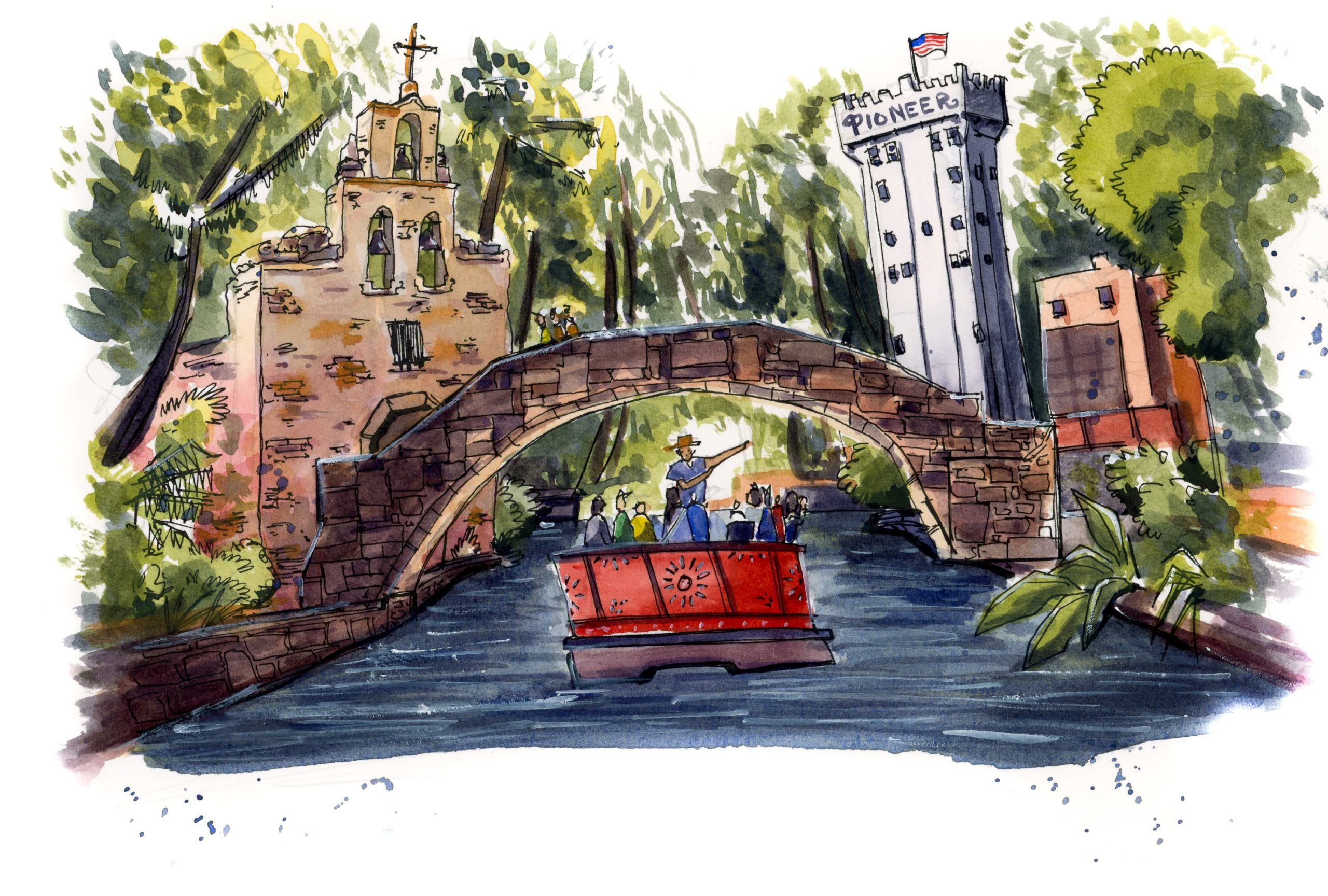
Part 1 of a four-part Urban Nerd series exploring the three distinct personalities of the San Antonio River Walk.
When I was a kid, I went on a school field trip to see the Alamo. Like most San Antonio students, that was my first real trip downtown. But what actually stuck with me wasn’t the Alamo. It was the River Walk.
I remember walking down from street level and feeling like I had entered a completely different world. I had never experienced the difference between the busy streets above and the calm water below. The boats were the coolest thing I had ever seen, and the fact that the river ran straight into Rivercenter Mall blew my mind. For a kid, that was peak San Antonio magic.
As I got older, though, I told myself the River Walk wasn’t really for me. It was for visitors. People coming to see the Alamo, attend conventions, or visit family. It was where you took out of towners for dinner, not where locals spent time.
But that’s all changed. The river has grown, both literally and culturally.
Over the last two decades, the San Antonio River Walk has expanded into something bigger, more dynamic, and far more importantly, local. The water that once defined downtown has become a thread stitching together three distinct personalities. Three San Antonios that coexist along the same current.
And that’s what this series is about. How one river can represent three different versions of who we are as a city.
What is it?
The San Antonio River Walk was born from a vision that almost never happened. In 1921, a devastating flood killed 50 people and left the city searching for a way to control the river. Some leaders wanted to pave it over entirely.
Enter Robert H. H. Hugman, a young architect who imagined something radical: a linear park that would celebrate the river instead of hiding it. “Let us make this river a thing of beauty, unique in all the world,” he urged.
His idea took decades to fully bloom. The first walkways opened in 1941, establishing the downtown River Walk as the city’s signature attraction. But the story didn’t end there.
In 2001, the city launched the San Antonio River Improvements Project, a $384 million collaboration between the City, Bexar County, and the San Antonio River Authority. Its goal was to restore the river’s ecosystem, expand its reach, and reconnect it to neighborhoods north and south of downtown.
The project produced two major expansions: the Museum Reach in 2009 and the Mission Reach in 2013. Together they transformed the River Walk into a 13 mile network of trails, parks, and gathering places. An unbroken line of water and walkways that redefined the way the city moves.
Where is it?
If you think of the San Antonio River Walk as one place, you’re missing the best parts of it.
The first river is the one everyone knows. The downtown stretch is lined with umbrellas, mariachi music, and riverboats. It loops around the Alamo, connects to Rivercenter Mall, and draws millions of visitors each year. It’s the beating heart of our hospitality economy, home to conventions, family trips, and celebrations of every kind.
The second river lies north of downtown. The stretch locals call River North. It runs from the edge of Brackenridge Park to the Thompson Hotel and is filled with apartments, restaurants, and everyday city life. Here you’ll find the San Antonio Museum of Art, Elsewhere Beer Garden, Make Ready Market, and the Pearl anchoring both ends. It’s the most walkable, lived in part of the river, the place where the city’s modern energy gathers.
The third river begins south of downtown at Blue Star Arts Complex and flows past Confluence Park toward Espada and the Missions. Known as the Mission Reach, it’s where San Antonians get active. Cycling, kayaking, and running along the water. It connects the modern city to our UNESCO World Heritage Missions, turning history and recreation into one continuous experience.
So yes, it’s one river. But it’s also three personalities: the Visitor’s River, the Local’s River, and the Active River.
Why it matters
I still remember the first time someone told me the River Walk was a linear park. I had never heard that term before, and it completely changed the way I saw it. The River Walk isn’t just an attraction. It’s a park. And like any great park, it belongs to everyone.
That’s what makes it so special. San Antonio was forward thinking enough to preserve its history while creating something new. Because it’s a park, everyone can enjoy it, and everyone does. The expansion has only made that more true.
Today, you’ll see people taking engagement photos near the Pearl, celebrating graduations on the bridges, and kayaking near the Missions. It’s become one of the most imaginative public spaces in Texas. A place that captures the spirit of San Antonio.
People from around the world now study how we did it. Cities from Oklahoma City to Houston have borrowed ideas from our river, inspired by how San Antonio turned infrastructure into identity.
The River Walk began as flood control. It became a cultural landmark. And in the process, it reminded us that the best public spaces are the ones built for everyone.
Citations
Urban development and regional planning: “Exploring the Mission Reach: A Remarkable Restoration Project”, Society for Ecological Restoration
Historical origins and design: “Robert H. H. Hugman: Architect of San Antonio’s Iconic River Walk (1902–1980)”, Texas State Historical Association
River Improvements Project and expansion details: “San Antonio River Walk – A Short History of Preservation and Urban Renewal”, The Cultural Landscape Foundation
Visitor data and economic impact: “San Antonio River Walk Museum Reach”, San Antonio River Authority
THE VOICE:
Lorenzo Gomez III

Lorenzo Gomez III is a community builder, author, and public speaker who draws from his personal and professional experiences to inspire others. A former director at Rackspace Technology, Gomez is a key player in the development of San Antonio’s downtown entrepreneurial ecosystem. During Gomez’s four years as chairman and CEO of Geekdom, San Antonio’s premier collaborative startup community, Geekdom companies raised more than $422M in funding and its startups have created 2,489 jobs. A trusted advisor to Graham Weston, co-founder of Rackspace Technology, Gomez helped shape Weston’s 80|20 Foundation, which invests in San Antonio’s future by issuing grants to public charities that attract, grow, and retain San Antonio’s future workforce and job-creating entrepreneurs. Gomez has authored four books: Cilantro Diaries, Tafolla Toro, The Rack We Built, and The Bully in Your Pocket. All four are Amazon best sellers and two are winners of the 2021 International Latino Book Awards. Lorenzo’s driving passion is his love for his hometown, San Antonio, Texas. His goal is to recreate for every San Antonian the opportunities the startup world has provided him in this city on the rise.