



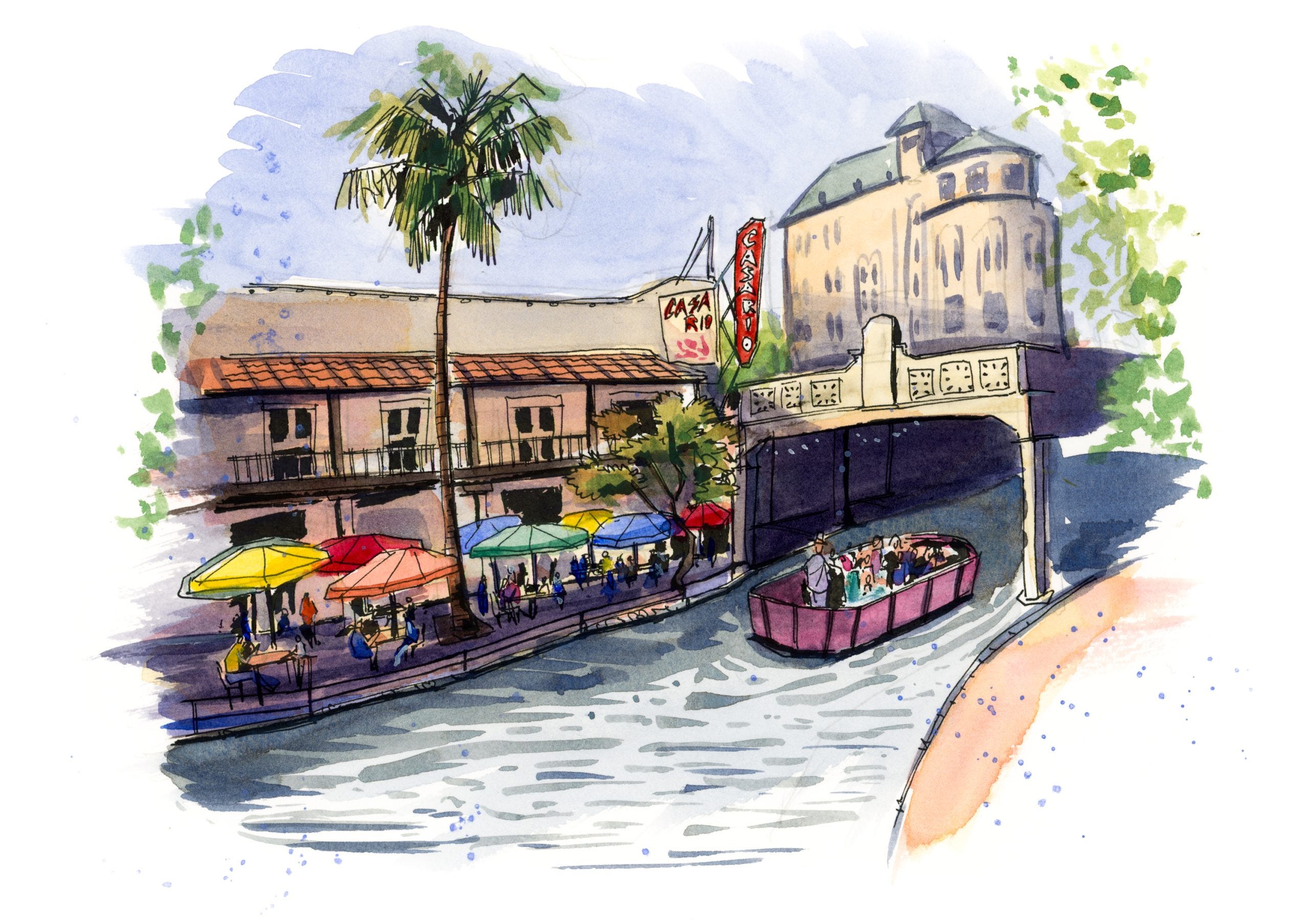
Part 2 of a four-part Urban Nerd series exploring the three distinct personalities of the San Antonio River Walk.
I’m embarrassed to admit this now, but for a long time, I had a terrible attitude about the River Walk.
Not the whole thing. Just the part I thought didn’t belong to me.
I saw the downtown stretch, the boats, the umbrellas, the restaurants packed with visitors, and I dismissed it. I told myself it was for tourists. It was where you took people from out of town, not where you spent your own time. It felt performative. Busy. A little too polished. I didn’t see myself in it, so I wrote it off.
And for years, I was completely wrong. Part of that realization came over time.
I started my career downtown at Rackspace in 2001, moved out of downtown in 2004, and didn’t return until 2011. When I came back, I didn’t just work downtown. I lived there. I spent two years in the Majestic Theater apartments and more than a decade building companies, walking those streets, and experiencing the city at ground level.
That changed how I saw everything.
Because when you live and work downtown, you start to understand something most people miss. The version of San Antonio that the world recognizes begins here. For better or worse, downtown is the brand.
And the Visitor’s River sits at the center of it.
It wasn’t until I started spending real time there that my perspective shifted. You notice patterns. You see where people gather, where money flows, where energy concentrates. What looks like surface level activity starts to reveal something much deeper.
The Visitor’s River is not just a place. It is an engine.
It is the foundation of one of San Antonio’s most important industries, hospitality, which supports more than 130,000 jobs across the region, many of them concentrated in and around the urban core. Hotels, restaurants, events, conventions, cultural institutions. Entire careers are built on the flow of people moving through this part of the city.
What I once dismissed as “for tourists” is in fact one of the primary ways our city creates jobs, generates revenue, and sustains families.
That realization alone forces you to rethink everything.
Because once you see it as an engine, you stop asking whether it’s for you and start asking what it does for everyone.
The Visitor’s River is where San Antonio introduces itself to the world.
It is where people come to understand who we are. They walk from the The Alamo to the river, often within minutes, and experience something that is difficult to replicate anywhere else. A historic site with global recognition paired with a public space that feels completely unique.
And it does more than entertain. It educates.
Visitors come to learn about the Alamo, about the Missions, about the story of Texas. They attend conventions at the Henry B. González Convention Center, wander through La Villita Historic Arts Village, explore Market Square, and spend time in Hemisfair. All of it is connected, physically and culturally, by the river itself.
That connectivity is not accidental. It is the result of a city choosing to invest in a shared space and then continuing to build around it.
For a long time, though, that is where the story stopped.
We built something extraordinary in the Visitor’s River. Then we paused.
For years, if someone came to town and asked a simple question, “Where do the locals go?” the answer was unclear. We had created a world class front door, but not enough rooms behind it. The experience was memorable, but it wasn’t complete.
That gap is what the rest of this series explores.
Because today, that question has a much better answer.
Now, when visitors ask where the locals are, we can point them north to the Local’s River, where daily life unfolds along the water. We can send them south to the Active River, where the city stretches out into miles of trails, parks, and history.
But none of that works without the foundation.
The Visitor’s River is still the front door. It is still the introduction. It is still the place where first impressions are formed and where the city tells its story most clearly.
And it is about to change.
In the coming years, the line between visitor and local will begin to blur in ways we have not seen before. New investments are converging around this part of downtown. A new ballpark to the northwest. Project Marvel and the Spurs moving into Hemisfair. The continued growth of downtown west. And the commitment from UT San Antonio to bring 10,000 students into the urban core.
For the first time in a long time, we are not just welcoming people to the Visitor’s River. We are surrounding it with everyday life.
My hope is that one day soon, you will not be able to tell the difference. That the same place once defined by visitors becomes just as defined by locals. That the energy flows both ways.
Because if we get that right, the Visitor’s River will not just be where San Antonio introduces itself to the world.
It will be where the city finally comes together.
Citations
Hospitality employment data (San Antonio metro):
U.S. Bureau of Labor Statistics
https://www.bls.gov/regions/southwest/tx_sanantonio_msa.htm
Visitor destinations and downtown assets:
City of San Antonio / Visit San Antonio
https://www.visitsanantonio.com
THE VOICE:
Lorenzo Gomez III

Lorenzo Gomez III is a community builder, author, and public speaker who draws from his personal and professional experiences to inspire others. A former director at Rackspace Technology, Gomez is a key player in the development of San Antonio’s downtown entrepreneurial ecosystem. During Gomez’s four years as chairman and CEO of Geekdom, San Antonio’s premier collaborative startup community, Geekdom companies raised more than $422M in funding and its startups have created 2,489 jobs. A trusted advisor to Graham Weston, co-founder of Rackspace Technology, Gomez helped shape Weston’s 80|20 Foundation, which invests in San Antonio’s future by issuing grants to public charities that attract, grow, and retain San Antonio’s future workforce and job-creating entrepreneurs. Gomez has authored four books: Cilantro Diaries, Tafolla Toro, The Rack We Built, and The Bully in Your Pocket. All four are Amazon best sellers and two are winners of the 2021 International Latino Book Awards. Lorenzo’s driving passion is his love for his hometown, San Antonio, Texas. His goal is to recreate for every San Antonian the opportunities the startup world has provided him in this city on the rise.