



(This is Part 5 in a 12-part series on San Antonio’s Sports & Entertainment District, aka Project Marvel.)
Of all the issues people raise about Project Marvel, nothing sparks louder debate than the so-called “three arenas.” The comment threads light up, the arguments spiral, and the criticism is fierce.
Beneath all that noise, though, are two very reasonable objections.
First: why do we need a third arena? From the outside, it looks like the Spurs already had the Alamodome, then go the Frost Bank Center, and now we want another one.
Second: how many times can the city promise something big without delivering? We were told the Alamodome might bring an NFL franchise. It didn’t. We were told the Frost Bank Center would spark East Side development. It didn’t. So why should people believe the promises tied to this new arena will be any different?
Those are fair questions, and they deserve real answers.
The Alamodome
Promises
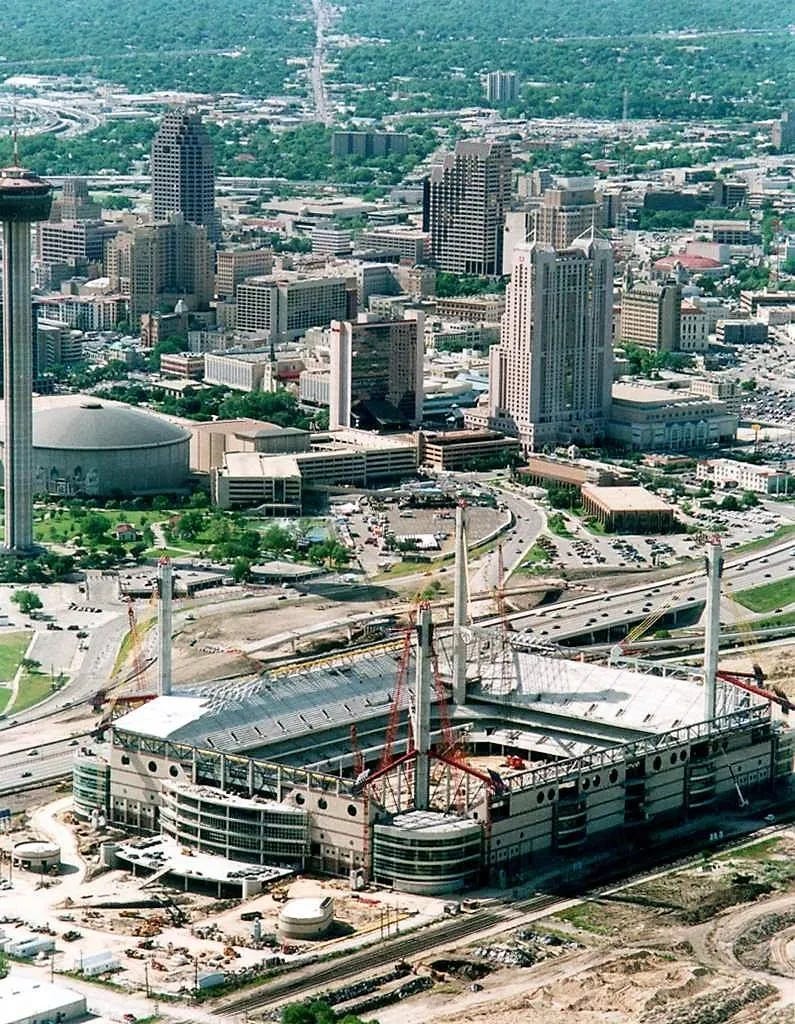
When San Antonio voters approved the Alamodome in 1989, the pitch wasn’t about the Spurs. It was about chasing the NFL and putting the city on the national stage. The Dome was designed with football in mind, a bid for the NFL, not a solution for NBA basketball.
What often gets lost in today’s debate is that the Spurs never asked for the Alamodome. They didn’t lobby for it, didn’t design it, and didn’t need it. Their home court at the time, HemisFair Arena, was demolished, and the Dome became the only available option. In moving there, the Spurs were essentially doing the city a favor by keeping the building alive for a decade.
That distinction matters. Critics today often frame a new arena as the team’s “third request.” In reality, the Spurs have only ever asked twice: once in 2002 for the Frost Bank Center, and again now. The Alamodome was a civic project, not part of the Spurs’ wish list.
Delivery
In its 32 years, the Alamodome has generated an estimated $4 billion economic impact for San Antonio†. The Alamodome is in a class all of its own, unmatched in size and versatility anywhere else in South Texas.
Capacity: 65,000 people, more than triple the size of the next-largest indoor venue in the region, the Frost Bank Center at about 18,000 seats.
Status: the third-largest indoor domed stadium in Texas, behind NRG Stadium in Houston and AT&T Stadium in Arlington.
Impact: the 2025 Men’s Final Four drew 100,000 visitors and generated $440 million†.
Beyond those headline events, the Dome stays active year-round with UTSA football, graduations, home and garden shows, cheer competitions, marching band championships, and Disney on Ice.
And here’s the kicker: if Taylor Swift ever brings her tour to San Antonio, the Alamodome is the only venue within several hundred square miles big enough to host her.
The Dome doesn’t just keep us nostalgic. It keeps us competitive. Without it, San Antonio falls behind Dallas, Houston, and others in landing marquee events.
Future
If there’s one thing everyone agrees on, it’s that the Alamodome’s biggest headache is parking and traffic. Getting in and out can feel like its own sport. Project Marvel also includes a bond proposal aimed directly at infrastructure improvements around the Dome.
The Frost Bank Center
Promises
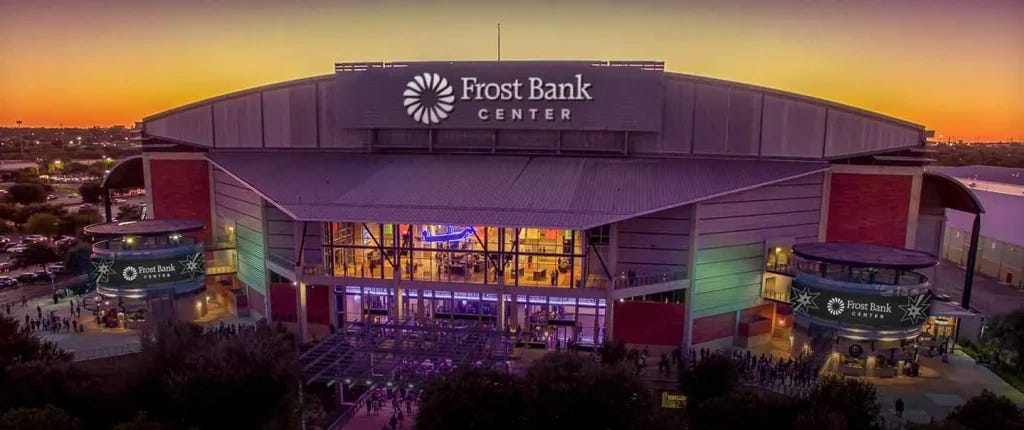
When voters approved the Frost Bank Center (then the SBC Center) in 1999, the pitch wasn’t just basketball. It was supposed to catalyze investment and spark new life on the East Side.
Interestingly, one of the Spurs’ original plans in the early 2000s was to build the new arena downtown, adjacent to the Alamodome, to create exactly the kind of district and density we’re now arguing for.† In a last-minute change, however, they partnered with Bexar County to build the facility next to the Freeman Coliseum, what we now know as the Frost Bank Center.†
Delivery
Two decades later, the arena worked for the Spurs but failed the neighborhood. It became another island, a sea of parking lots where people streamed in for games and streamed back out.
That frustration is real, and it fuels skepticism today.
In October 2024, ESPN insiders ranked the Frost Bank Center dead last among all NBA arenas in accessibility, food, and overall fan experience, underscoring how far it has fallen behind NBA standards.†
At over 20 years old, the Frost Center would require massive renovations. Modernizing outdated systems can approach the cost of building new†. Even if updated, it lacks the premium seating, luxury suites, immersive technology, and integration into a district† that today’s NBA facilities rely on.
Future
But here’s the opportunity: the Frost Bank Center won’t sit idle. It could finally fulfill its promise, just in a different role.
On Bob Rivard’s Big City, Small Town podcast, Rodeo CEO Cody Davenport painted the vision: a true Western District†.
The San Antonio Stock Show & Rodeo already brings 1.5 million people in 22 days, with visitors from 69 countries. Over 75 years, it has awarded $286 million in scholarships and grants†. Few rodeos in the world rival its scale.
And the Western industry isn’t just holding steady. It’s growing. PBR (Professional Bull Riders) reported more than 1 million attendees at its events in 2023, with ticket sales up 23 percent year-over-year†. The Houston Livestock Show and Rodeo drew 2.7 million people in 2025, a record-setting crowd†.
With year-round control of the Frost Bank Center grounds, the Rodeo has the potential to transform the site into a true Western District, a self-contained ecosystem of equestrian events, livestock shows, concerts, and expos. Instead of sitting dark, the site could become a cultural and economic engine, the kind of destination where you might even imagine filming scenes from Yellowstone.
That’s not redundancy. That’s reinvention.
From Islands to Districts: Why This Time Is Different
The Alamodome and Frost Bank Center were products of a familiar San Antonio mistake: build isolated islands and hope for momentum. It rarely came.
What’s different now is the pivot to districts. The Frost Bank Center will evolve into a Western District. And for the first time, the Spurs arena and the Alamodome will sit inside the same downtown district, creating density on par with what you’d see in Barcelona or São Paulo, not the piecemeal San Antonio of old.
Three arenas, yes, but with three distinct purposes:
The Alamodome as our mega-event powerhouse.
The Frost Bank Center as a Western District hub.
A new Spurs arena as a modern NBA anchor embedded in a thriving urban core.
And San Antonio isn’t alone. More than 300 global stadium projects are underway in 2025, nearly half in North America and Europe. Increasingly, these aren’t just arenas. They’re stadium districts†, built to keep fans engaged, generate year-round revenue, and anchor community growth. Other cities have figured out you can’t build arenas in isolation. Districts are how you make the promises stick.
That’s not waste. That’s the power of people and density. And it’s the kind of city-building San Antonio has been waiting decades to get right.
(This is Part 5 in a 12-part series on San Antonio’s Sports & Entertainment District, aka Project Marvel.)
Of all the issues people raise about Project Marvel, nothing sparks louder debate than the so-called “three arenas.” The comment threads light up, the arguments spiral, and the criticism is fierce.
Beneath all that noise, though, are two very reasonable objections.
First: why do we need a third arena? From the outside, it looks like the Spurs already had the Alamodome, then go the Frost Bank Center, and now we want another one.
Second: how many times can the city promise something big without delivering? We were told the Alamodome might bring an NFL franchise. It didn’t. We were told the Frost Bank Center would spark East Side development. It didn’t. So why should people believe the promises tied to this new arena will be any different?
Those are fair questions, and they deserve real answers.
The Alamodome
Promises
When San Antonio voters approved the Alamodome in 1989, the pitch wasn’t about the Spurs. It was about chasing the NFL and putting the city on the national stage. The Dome was designed with football in mind, a bid for the NFL, not a solution for NBA basketball.
What often gets lost in today’s debate is that the Spurs never asked for the Alamodome. They didn’t lobby for it, didn’t design it, and didn’t need it. Their home court at the time, HemisFair Arena, was demolished, and the Dome became the only available option. In moving there, the Spurs were essentially doing the city a favor by keeping the building alive for a decade.
That distinction matters. Critics today often frame a new arena as the team’s “third request.” In reality, the Spurs have only ever asked twice: once in 2002 for the Frost Bank Center, and again now. The Alamodome was a civic project, not part of the Spurs’ wish list.
Delivery
In its 32 years, the Alamodome has generated an estimated $4 billion economic impact for San Antonio†. The Alamodome is in a class all of its own, unmatched in size and versatility anywhere else in South Texas.
Capacity: 65,000 people, more than triple the size of the next-largest indoor venue in the region, the Frost Bank Center at about 18,000 seats.
Status: the third-largest indoor domed stadium in Texas, behind NRG Stadium in Houston and AT&T Stadium in Arlington.
Impact: the 2025 Men’s Final Four drew 100,000 visitors and generated $440 million†.
Beyond those headline events, the Dome stays active year-round with UTSA football, graduations, home and garden shows, cheer competitions, marching band championships, and Disney on Ice.
And here’s the kicker: if Taylor Swift ever brings her tour to San Antonio, the Alamodome is the only venue within several hundred square miles big enough to host her.
The Dome doesn’t just keep us nostalgic. It keeps us competitive. Without it, San Antonio falls behind Dallas, Houston, and others in landing marquee events.
Future
If there’s one thing everyone agrees on, it’s that the Alamodome’s biggest headache is parking and traffic. Getting in and out can feel like its own sport. Project Marvel also includes a bond proposal aimed directly at infrastructure improvements around the Dome.
The Frost Bank Center
Promises
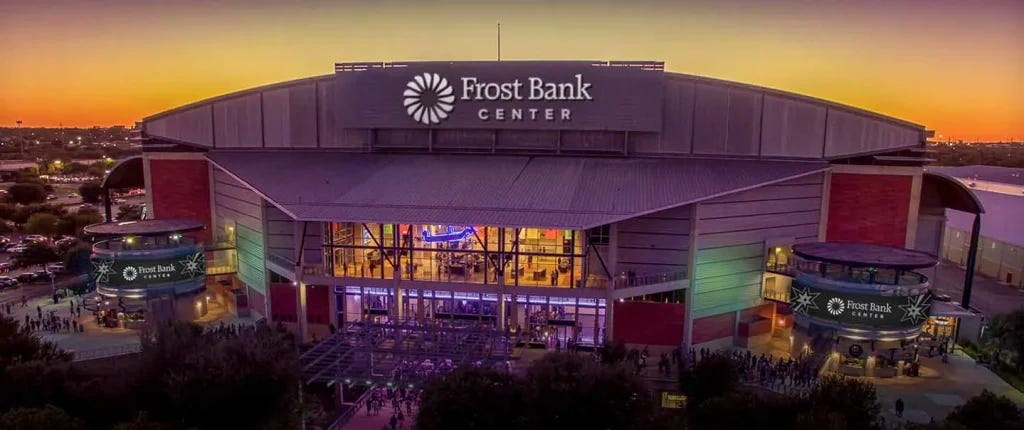
When voters approved the Frost Bank Center (then the SBC Center) in 1999, the pitch wasn’t just basketball. It was supposed to catalyze investment and spark new life on the East Side.
Interestingly, one of the Spurs’ original plans in the early 2000s was to build the new arena downtown, adjacent to the Alamodome, to create exactly the kind of district and density we’re now arguing for.† In a last-minute change, however, they partnered with Bexar County to build the facility next to the Freeman Coliseum, what we now know as the Frost Bank Center.†
Delivery
Two decades later, the arena worked for the Spurs but failed the neighborhood. It became another island, a sea of parking lots where people streamed in for games and streamed back out.
That frustration is real, and it fuels skepticism today.
In October 2024, ESPN insiders ranked the Frost Bank Center dead last among all NBA arenas in accessibility, food, and overall fan experience, underscoring how far it has fallen behind NBA standards.†
At over 20 years old, the Frost Center would require massive renovations. Modernizing outdated systems can approach the cost of building new†. Even if updated, it lacks the premium seating, luxury suites, immersive technology, and integration into a district† that today’s NBA facilities rely on.
Future
But here’s the opportunity: the Frost Bank Center won’t sit idle. It could finally fulfill its promise, just in a different role.
On Bob Rivard’s Big City, Small Town podcast, Rodeo CEO Cody Davenport painted the vision: a true Western District†.
The San Antonio Stock Show & Rodeo already brings 1.5 million people in 22 days, with visitors from 69 countries. Over 75 years, it has awarded $286 million in scholarships and grants†. Few rodeos in the world rival its scale.
And the Western industry isn’t just holding steady. It’s growing. PBR (Professional Bull Riders) reported more than 1 million attendees at its events in 2023, with ticket sales up 23 percent year-over-year†. The Houston Livestock Show and Rodeo drew 2.7 million people in 2025, a record-setting crowd†.
With year-round control of the Frost Bank Center grounds, the Rodeo has the potential to transform the site into a true Western District, a self-contained ecosystem of equestrian events, livestock shows, concerts, and expos. Instead of sitting dark, the site could become a cultural and economic engine, the kind of destination where you might even imagine filming scenes from Yellowstone.
That’s not redundancy. That’s reinvention.
From Islands to Districts: Why This Time Is Different
The Alamodome and Frost Bank Center were products of a familiar San Antonio mistake: build isolated islands and hope for momentum. It rarely came.
What’s different now is the pivot to districts. The Frost Bank Center will evolve into a Western District. And for the first time, the Spurs arena and the Alamodome will sit inside the same downtown district, creating density on par with what you’d see in Barcelona or São Paulo, not the piecemeal San Antonio of old.
Three arenas, yes, but with three distinct purposes:
The Alamodome as our mega-event powerhouse.
The Frost Bank Center as a Western District hub.
A new Spurs arena as a modern NBA anchor embedded in a thriving urban core.
And San Antonio isn’t alone. More than 300 global stadium projects are underway in 2025, nearly half in North America and Europe. Increasingly, these aren’t just arenas. They’re stadium districts†, built to keep fans engaged, generate year-round revenue, and anchor community growth. Other cities have figured out you can’t build arenas in isolation. Districts are how you make the promises stick.
That’s not waste. That’s the power of people and density. And it’s the kind of city-building San Antonio has been waiting decades to get right.
Citations
Alamodome history and economic impact – San Antonio Report
Rodeo data and Western District vision – Front Office Sports
Rodeo data and Western District vision– Wikipedia
Spurs arena location history – Wikipedia
Spurs arena location history – San Antonio Express-News
National sports district trend – Wall Street Journal
THE VOICE:
Lorenzo Gomez III

Lorenzo Gomez III is a community builder, author, and public speaker who draws from his personal and professional experiences to inspire others. A former director at Rackspace Technology, Gomez is a key player in the development of San Antonio’s downtown entrepreneurial ecosystem. During Gomez’s four years as chairman and CEO of Geekdom, San Antonio’s premier collaborative startup community, Geekdom companies raised more than $422M in funding and its startups have created 2,489 jobs. A trusted advisor to Graham Weston, co-founder of Rackspace Technology, Gomez helped shape Weston’s 80|20 Foundation, which invests in San Antonio’s future by issuing grants to public charities that attract, grow, and retain San Antonio’s future workforce and job-creating entrepreneurs. Gomez has authored four books: Cilantro Diaries, Tafolla Toro, The Rack We Built, and The Bully in Your Pocket. All four are Amazon best sellers and two are winners of the 2021 International Latino Book Awards. Lorenzo’s driving passion is his love for his hometown, San Antonio, Texas. His goal is to recreate for every San Antonian the opportunities the startup world has provided him in this city on the rise.